Keep your pelvis level without flattening your hip
You need support beneath your pelvis and enough give at the surface for your hip and shoulder to sink a little. Those are separate jobs. A sagging mattress or an overly soft core lets your pelvis drop, so your lower back stays bent or twisted for hours. At the other extreme, a thin quilt over a hard spring unit presses against a side sleeper's hip and shoulder. You can end up rolling onto your back simply because your side feels uncomfortable.
To my mind, "firmer is better for your back" is the most expensive misunderstanding in mattress shopping. In Radwan and colleagues' 2015 systematic review , medium-firm came out as the best-supported starting point across 24 controlled trials published since 2000 in adults with or without back pain. The moderate- to high-quality trials used subjective firmness descriptions; medium-firm and custom-inflated mattresses were identified as optimal for sleep comfort, sleep quality and spinal alignment.1
“ Results of this systematic review show that a mattress that is subjectively identified as a medium-firm mattress and is custom inflated (self-adjusted) is optimal for promoting sleep comfort, quality, and spinal alignment.
The word "medium" is still a bloody loose arrangement between mattress makers. Ignore the assumption that it feels the same across brands, because each uses its own descriptions. Compare how far you sink and whether you can settle on your side. A soft surface over a supportive core feels quite different from a mattress that gives way beneath your whole middle.
I start with how much weight the mattress has to support, then adjust for your sleeping position. Use these directions to narrow your search; they are shopping rules of thumb, with no clinical weight thresholds.
Your build or sleeping habit Where to begin What to check when you lie down You are lighter A softer comfort layer over a supportive core Your hip and shoulder should sink enough that you can settle without pressure from the surface. You are heavier A firmer, supportive core with proper cushioning above it Your pelvis should stay supported instead of dropping much lower than the rest of you. You sleep mainly on your side A little more surface cushioning for your build You should be able to stay on your side without rolling away from a hard surface. You sleep mainly on your back A level, supportive feel with less need for deep cushioning Your pelvis should stay level and turning should feel straightforward.
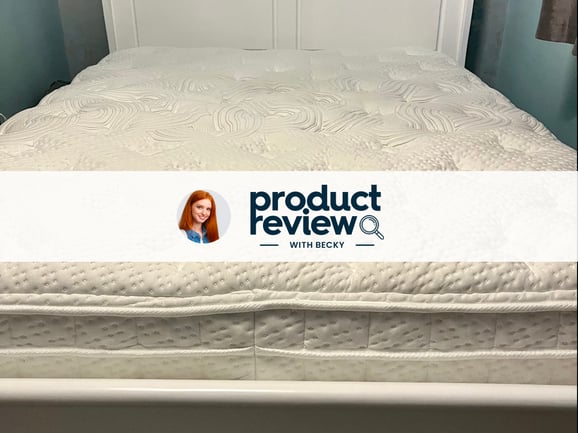
For the wider firmness question, our mattresses for back pain guide covers the buying considerations beyond sciatica. Keep your attention on the core and comfort layer when comparing constructions; the stitched pattern on top tells you very little about either.
Side or back sleeping gives you a practical place to start
For comfort, I'd try your side with a pillow between your knees, or your back with a pillow beneath them. These are the positions I favour for someone with sciatica. If your physio has advised a particular position for you, follow their advice over mine.
On your side, the pillow between your knees helps keep your pelvis level instead of letting the upper leg fall across your body. The mattress still needs to give beneath your hip and shoulder. You shouldn't have to arrange half the linen cupboard around yourself to tolerate a hard surface, so test the mattress in that position before adding more pillows.
A pillow under your knees is the back-sleeping option I would try next. You need steady support beneath your pelvis, with enough softness to settle comfortably. Start with a pillow you already own and adjust its position to suit you. Buying a special pillow before trying the ordinary one is exactly the sort of shopping enthusiasm I recognise, but there is no need to begin there.
Front sleeping is the position I'd talk you out of when choosing for sciatica. It is harder to avoid a dipped lower back and a turned neck in that position. If you keep returning to your front, tell your physio how you actually sleep so their advice accounts for it. Buying for the position you hope to maintain all night is a poor substitute for checking the one you wake up in.
Our mattresses for side sleepers guide goes further into cushioning. For this choice, keep the check simple: your hip needs room to sink a little while your pelvis remains supported.
A stable edge and an easy turn matter as much as lying still
Choose a bed you can sit on, turn on and stand up from comfortably. A mattress that feels agreeable once you're perfectly arranged can still be awkward when you need to move. Nobody sleeps in the showroom's tidy little demonstration pose all night, so include getting out in your shop visit.
Springs and latex give a more responsive feel: when you move, the surface changes shape readily beneath you. Deep memory foam gives more of an enveloping feel, and some people find turning in it like getting out of quicksand. For anyone who has to move carefully, I favour a responsive hybrid over deep, slow-sinking foam.
Memory foam remains an option if you enjoy the close cushioning and can turn comfortably on it. If you already sleep hot, though, choose springs with a different comfort layer; memory foam can feel warm. I wouldn't choose it on the strength of an impressive cooling name. The trade does enjoy naming a fabric as though it needs its own launch event.
A stable edge gives you somewhere secure to sit before standing. Check it with your weight properly on the edge, because a brief perch won't tell you much. Bed height matters too: your feet should rest flat on the floor when you sit there. Test the mattress and base together where possible, since their combined height is what you will use at home.
The NHS advice on sciatica says, "do not sit or lie down for long periods, even if moving hurts".2
Test your usual position and keep a workable return option
Begin with a medium-firm hybrid or pocket-spring mattress with a real comfort layer, then test it in the position you use at home. Latex or springy foam are sensible options for cushioning with easier movement. A thin quilt over a firm unit offers little room for your hip to sink, however elaborate the stitching.
In a shop, spend a full ten minutes lying as you normally sleep. Keep your coat off and your phone away; this is one shopping trip where lying down properly counts as effort. Notice whether your pelvis drops, whether your shoulder feels pressed, and whether you can roll over easily. A showroom visit is best for ruling out obvious mismatches. It tells you much less about a whole night.
If your mattress is sound but too firm, try a softer topper before replacing the lot. It is the cheaper way to find out whether extra surface cushioning suits you. A topper cannot repair a sag, including a firm topper sold as the answer to a soft bed. You would still have the same dip underneath, just with another purchase on top.
Allow for adjustment during the first fortnight, and judge patterns across several nights and across a flare instead of treating one morning as the result. Night one gets far too much authority in mattress shopping. Write down where you felt pressure and how easily you turned, because remembering the exact feel of Tuesday's mattress by Sunday is harder than it sounds. New or worsening symptoms need medical attention under the NHS guidance; an adjustment period is no reason to put that off.
Before paying, read the return terms for collection charges and any minimum-use or condition requirements. Check whether you receive a refund or an exchange, and whether using a topper affects the terms. Save a copy with your order confirmation. A trial is useful only if you can meet the conditions and afford any return costs.
Avoid buying harder, covering a sag or delaying care
Leave extra-firm off your shortlist when the only reason for choosing it is that your leg hurts. I have no patience for the idea that a harder purchase proves you are taking your back seriously. Equally, keeping a sagging mattress because the top still feels cosy confuses softness with support. The surface cuddle is only part of the job.
Extra-firm chosen because of sciatica: start with medium-firm and adjust for your build and comfort instead of automatically choosing the hardest option.A soft, sagging mattress kept because it feels comfortable at first: the pelvis can still drop once you settle into it.A firm topper over a dip: the underlying sag remains, so check the mattress and base before spending on a topper.Front sleeping: side or back sleeping is the comfort option I favour, with your physio's advice taking priority.Waiting for a delivery when an urgent symptom appears: follow the NHS emergency instructions immediately if you have any symptom on its 999 list.
When sciatica needs urgent care, not a mattress
Some sciatica needs medical assessment rather than a different bed. NHS guidance on sciatica says to go to A&E or call 999 if you have sciatica on both sides, have weakness or numbness in both legs that's severe or getting worse, have numbness around or under your genitals or around your bottom (anus), find it hard to start peeing, cannot pee or cannot control when you pee and this is not normal for you, or do not notice when you need to poo or cannot control when you poo.
See a GP if you have sciatica and the pain has not improved after trying home treatments for a few weeks, is getting worse, or is stopping you doing your normal activities. The NHS self-help advice is to carry on with your normal activities as much as possible, try regular exercises for sciatica, start gentle exercise as soon as you can, hold heat packs to the painful areas and ask a pharmacist about painkillers, and not to sit or lie down for long periods, even if moving hurts.