The mistakes I see most often come from the terms and practicalities rather than the mattress itself. Use the complete mattress buying guide to choose the type and feel, then work through this list before paying: check the returns terms, whether it fits your frame and how you'll get it into the bedroom.
Choosing a mattress in brief
Settle the type and feel first, then check whether the purchase works for your budget and home. Compare the cost per night of use, read the trial and returns terms, and check the guarantee. Measure your frame and the route into the bedroom, then confirm delivery and old mattress removal arrangements. Buy online and you have 14 days to tell the seller you've changed your mind, then another 14 to send it back, unless the hygiene seal is broken.
Check whether you need a new mattress yet
Sagging where you lie or waking stiffer than you went to bed are the usual reasons to start looking for a replacement. Before you commit to buying, use the mattress replacement checker to help you decide whether it's time to replace yours.
Judge mattress value by its cost per night
The sticker price counts for less than what you pay per night over the years you keep the mattress. Use the cost-per-night calculator to do the sum, with a realistic estimate of how long you'll use it.
A cheap mattress you replace sooner can cost more per night than one you keep for longer. That's a good reason to look beyond the cheapest option, without stretching your budget beyond what you can afford.
Settle the mattress type and feel first
Memory foam, pocket spring, hybrid and latex mattresses feel very different, so don't treat them as interchangeable. If you'd rather answer questions to narrow your choice, use the mattress quiz.
Pick the group that matches how you sleep
Choose the group that matches how you spend the night.
Check the trial, returns and guarantee before you pay
A sleep trial is the retailer's own offer, so the return conditions matter as much as its length. When comparing mattresses with a sleep trial, check how long the trial lasts and whether you must keep the mattress for a minimum time before returning it. Check who pays for collection too: an unwanted mattress is awkward enough without an unexpected collection bill.
For online purchases, Citizens Advice says you have a cooling-off period: tell the seller within 14 days of receiving the item, then you have another 14 days to send it back.1 There doesn't need to be anything wrong with it. There is no cooling-off period for items custom-made for you or with a broken hygiene seal, so check how the mattress is sealed before you open it. In a shop, a change-of-mind return depends on the shop's own policy.
A guarantee adds to your legal rights. As Citizens Advice explains, you have legal rights for up to 6 years, or 5 in Scotland, if there's a fault. Read what the guarantee covers before paying.2 Its length alone isn't a good reason to choose a mattress.
Measure your bed frame and the route into the bedroom
The size name alone isn't enough to know whether a mattress will fit. Sizes vary slightly between brands, so measure the inside of your bed frame or divan and compare it with the mattress's listed size.
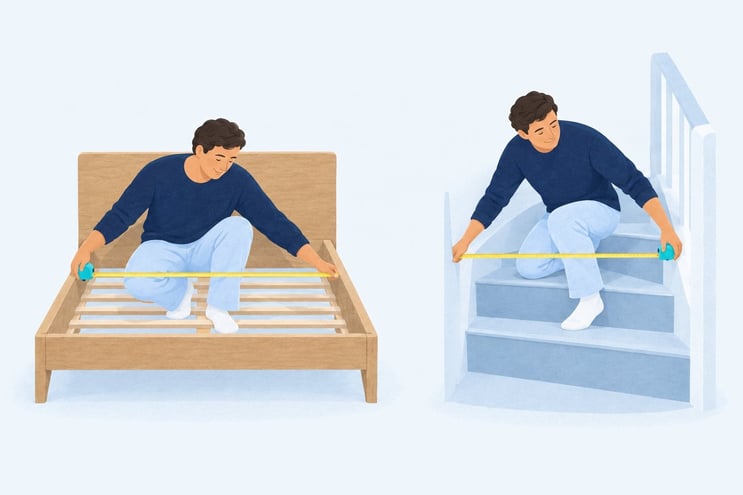 Measure inside your bed frame, then the doorways, stairs and tight turns on the way to the bedroom.
Getting it through the front door is only part of the job. Measure doorways, the stairs and any tight turns on the way to the bedroom too. If access is awkward, consider a bed-in-a-box mattress, which arrives rolled, and check that the box will fit through.
Ask about delivery and old mattress removal before ordering
Don't assume delivery includes carrying the mattress upstairs or taking the old one away. Ask the retailer exactly what's included so you're not left arranging help on delivery day.
- Will you deliver to the room I want it in?
- Is there a delivery charge?
- Will you take my old mattress away, and how much does that cost?
- Do I need to book removal when I order?
- What happens if the mattress doesn't fit?
If you're arranging disposal yourself, use our guide to recycling a mattress to explore your options.
Shops let you try the feel; online shopping gives you a wider comparison
A shop visit is useful when you're unsure what feels comfortable. Online shopping lets you compare many retailers at once, but you rely on the sleep trial to find out how the mattress feels.
| In a shop | Online |
|---|
| Trying it first | You can lie on the mattress before buying. | You choose before you've felt it and rely on the trial. |
|---|
| Changing your mind | Depends on the shop's own returns policy. | 14 days to cancel, then another 14 to send it back, unless the hygiene seal is broken. |
|---|
| Comparing | The range on display in that shop. | Mattresses across many retailers at once. |
|---|
If you visit a shop, lie on each mattress in your usual sleeping position for a full ten minutes; a quick sit on the edge tells you nothing. Honestly, a showroom is best for ruling mattresses out. Ask about the trial, guarantee and old mattress removal before you buy, while you've got someone there to explain the terms.
Questions people ask about choosing a mattress
Usually yes within the 14-day cooling-off period, but not if the hygiene seal is broken. A sleep trial is a separate retailer offer, so don't assume the two have identical conditions. Before opening the packaging, ask which return option applies if you unpack the mattress and decide it isn't comfortable. Get the answer in writing so you've got something to refer to later.
Only if the terms give you something useful beyond a longer guarantee period. Guarantees add to your legal rights, which last up to 6 years for faults, or 5 in Scotland. Ask what extra cover you're paying for and read the exclusions alongside it. I'd want a clear answer before spending more. A longer promise isn't much use if the problem you're concerned about is excluded.
Either works, provided you're happy with the returns, guarantee, delivery and removal arrangements. The deciding questions are the same whichever way you order. Ask for any assurances that matter to you in writing, especially if a salesperson has explained something differently from the published terms. Don't pay while that difference is unresolved: you need to know which arrangements you're agreeing to.