A sliding mattress usually has a cause you can find, so check what's letting it move before trying to hold it in place. Adding grip is a sensible fix, but it only works properly once you've dealt with the cause.
Stopping a mattress sliding in brief
Check what's letting your mattress move before adding grip: missing rails, a mattress smaller than the frame, an uneven base, no headboard, or an older mattress that's gone slippery underneath. Once you've dealt with the cause, use a non-slip pad, carpet tape round the frame edges or velcro strips to help hold it in place. Keep the base clean so dust doesn't reduce the grip.
Most mattress sliding comes from too little friction or too much room
Dreams says sliding is often down to a lack of friction between the mattress and frame.1
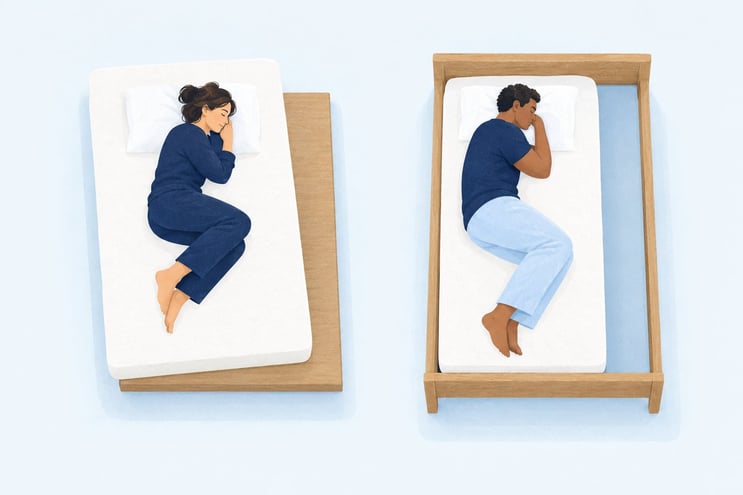 A base without rails, or a mattress smaller than its frame, gives the mattress room to slide.
- Look for rails. A raised edge above the slats helps hold the mattress in place.
- Check the sizes match. A mattress smaller than the frame has room to move inside it.
- Check the base and slats. The base should be level and the slats straight and unbroken, because an uneven or damaged base can let the mattress shift.
- Check for a headboard. Without one, or a frame tall enough to contain the mattress, there's less to stop it moving out of position.
- Feel the underside of an older mattress. Simba says body oils and sweat can make it slippery over time.2
Divan bases and platform beds have no slats or rails, so mattresses can slide on them too.
Add grip once you've fixed the cause
A pad is a straightforward place to start if you don't want to stick anything to your mattress. Tape and velcro strips need attaching, so choose whichever you're comfortable using on your bed.
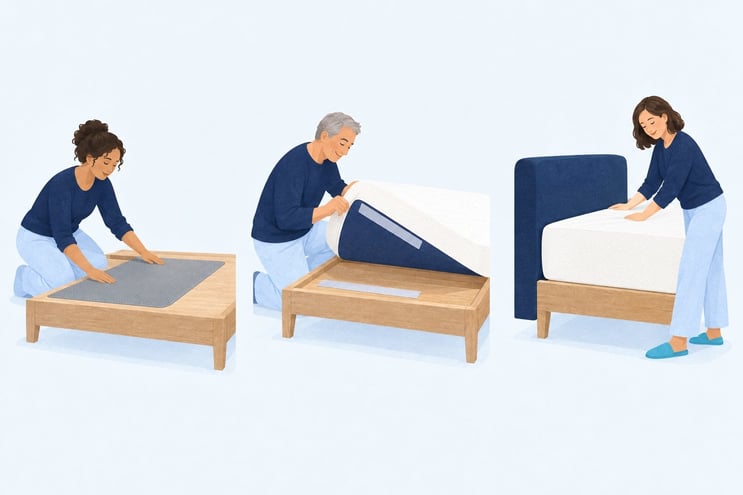 A pad, velcro strips or a headboard each give the mattress something to hold on to.
| Fix | How it works | Worth knowing |
|---|
| Non-slip pad | A thin rubber pad between mattress and base gives the mattress something to grip. | Buy the size that matches your mattress. You shouldn't feel it. |
|---|
| Carpet tape | Tape round the edges of the frame, with the mattress on top. | The cheaper option, and nothing goes on the mattress itself. |
|---|
| Velcro strips | One side on the base, the other on the underside of the mattress. | Line the strips up so they join. |
|---|
| Headboard | Helps hold the mattress in place. | Limits movement at the head end, so pair it with a pad. |
|---|
I'd rather put tape on the frame than stick anything to the mattress itself.
Keep the base clean and turn the mattress only as its label says
Dust the slats or vacuum the platform: Dreams says dirt on an old mattress's underside can make it slide. Rotate or flip the mattress only as its care label says. If an old mattress keeps sliding on a sound base, use the mattress replacement checker to help decide whether it's time to replace it. A broken frame or one that's the wrong size is a reason to look at new bed frames; adding more grip won't fix either problem.
Questions people ask about a sliding mattress
A divan has no rails to hold your mattress in place. Platform beds have the same problem. Add a headboard to limit movement at the head of the bed, and use a non-slip pad underneath to increase grip.
Yes, it can, because body oils and sweat can form a slippery film on the underside. Dirt also gathers there over time and reduces grip. Keep the base clean so you're not leaving the mattress resting on a dusty surface that makes sliding easier.
No, a thin non-slip pad shouldn't change how your mattress feels. It sits between the mattress and the base, where it adds grip without a noticeable extra layer beneath you. Choose a pad that matches your mattress size so it covers the area you need.