Maybe it's the bunk bed your sister's two have finally grown out of, or one from a local selling page that was too good to pass up. Right now it's in pieces along the hallway with a carrier bag of bolts, and you've got two children who both want the top. This is for the parent standing over those pieces, working out who sleeps where, what to check before anyone climbs up, and how you'll know when the bed has had its day.
Six is the earliest age for the top bunk. RoSPA, the Royal Society for the Prevention of Accidents, recommends that no child under six sleeps on or uses the upper bunk, and the Child Accident Prevention Trust doesn't recommend the top bunk under six either. RoSPA's Jim Oram says high sleepers are generally recommended for six and over too, and for a cabin bed or a mid-sleeper the age to go by is the maker's minimum for that model. Turning six is where the conversation starts, though, because your child still has to manage the ladder at night and keep to the rules. Before anyone sleeps in a handed-down bunk, Jim's advice is to check that it complies with BS EN 747 and has no damage, build it to the maker's instructions, give it a new mattress at the maker's size and depth, and keep it away from windows, light fittings and blind cords.
What are you trying to sort out?
- Which child can go on top
- Whether a handed-down bunk is ready to use
- Which mattress goes on it
- Where to put it in the room
- Whether they've outgrown it
What age for a top bunk, high sleeper, cabin bed or mid-sleeper?
The tall beds start at six, and the lower ones depend on the model in front of you. Jim Oram, Policy Officer for Home Safety at RoSPA, answered our questions on bunk beds and high sleepers in November 2026, and this is how he split the raised beds:
Start by working out which bed you've got. The top of a bunk and a high sleeper are the tall ones, with a ladder up and the sleeping space well off the floor, and six is where the advice starts for both. For cabin beds and mid-sleepers Jim gives no single number and sends you to the maker's minimum age for that specific model. With a handed-down bed that age is in the instructions, not on the bit of headboard in your hallway, so you'll need the make and model. The Child Accident Prevention Trust's advice on preventing falls in children gives six as well: children can have serious falls from the tops of bunk beds, so it doesn't recommend the top bunk for anyone under six, and it says to teach children not to play up there.1
Which bed, which age?
- Top bunk, under six: not yet. RoSPA recommends that children under six don't sleep on or use the upper bunk, and the Child Accident Prevention Trust doesn't recommend it either. That includes playing up there in the daytime.
- Top bunk, six or over: six is the earliest, and readiness decides it. Jim Oram's test is whether they can climb up and down safely, follow the rules every time and manage the ladder at night. Check the maker's own age and weight limits too.
- High sleeper, under six: not yet. Jim Oram says high sleepers are generally recommended for children aged six and over.
- High sleeper, six or over: Jim Oram's test is that your child can use the ladder safely and understands the bed is not a play area. Then check the maker's limits for that model.
- Cabin bed or mid-sleeper, under six: go by the maker's minimum age and instructions for that model, as Jim Oram advises. If you can't find them, ask the maker before your child uses it.
- Cabin bed or mid-sleeper, six or over: still the maker's minimum age for that model first, then Jim Oram's test: using the ladder safely and understanding the bed isn't a play area.
Turning six doesn't settle it on its own, and I'd take that part as seriously as the number. You know your child better than any age limit does: whether they bound up a ladder and stop to show off at the top, whether they wander to the loo half asleep at two in the morning, whether the house rules survive a friend staying over. Jim covered readiness in the first answers he gave us, and his list goes well beyond the ladder:
If any of that sounds like your child, I'd let the top bunk wait however old they are, even with a seven-year-old campaigning hard for it. Sort the night light today: one that plugs straight into the socket has no flex to trail across the floor, and you can clear the path from the foot of the ladder to the door while you're down there. Where you've got one child over six and one under, the older one gets the top and the younger one stays off it, ladder included.
Second-hand bunk bed checks before anyone sleeps in it
A handed-down bunk is a perfectly sensible way to furnish a shared room, and it needs a proper going-over before the first night. Beds that have been taken apart and moved tend to come back with a wobble or a bolt short. Jim's answer on second-hand and handed-down bunks starts with three checks.
He went on to say that the bed must suit the child's age and that the mattress should be replaced with a new one, at the size and depth the maker's instructions give. His list for raised beds says to check the bed's safety information, so that's where I'd look for BS EN 747: any label on the frame, and the instruction leaflet. The instructions are the bit that goes missing. They went in a drawer three house moves ago and nobody has seen them since, so ask whoever's passing the bed on for the make and model before it leaves their house, and get a copy from the maker. Search the same make and model on GOV.UK's product safety alerts, reports and recalls, the Office for Product Safety and Standards' searchable list of unsafe products and recalls.
Start the build with the bag of bolts.2 A flat-pack bed that's been moved has a way of coming back with one fewer fixing than it left with, and a bunk is not the bed to finish with whatever's rattling round the kitchen drawer. Lay everything out on a sheet and count it against the parts list, then get the missing pieces before you start. A cracked slat or a bent ladder hook gets replaced before use, as Jim says.
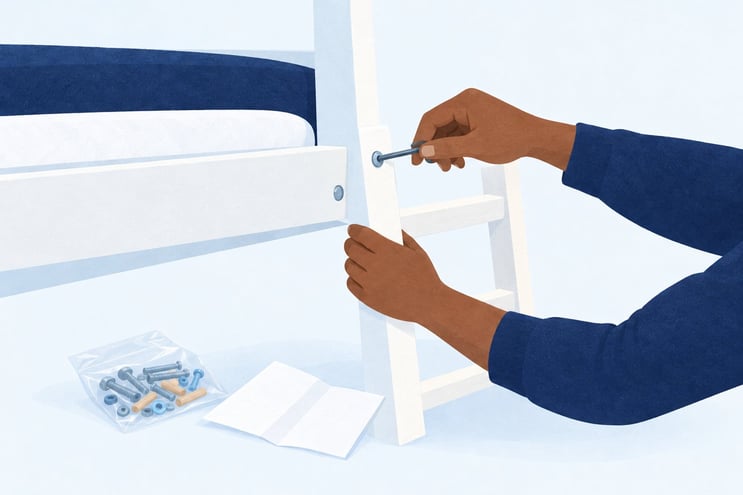 Count the fixings against the parts list before you start, and tighten each bolt as the instructions say.
- BS EN 747, the standard Jim Oram says to check for, named in the bed's safety information
- The maker's instructions, or the make and model so you can get them
- The maker's minimum age, maximum user weight and mattress size and depth limits, written down
- No recall for that make and model on GOV.UK
- Frame: no cracks, splits or bent metal
- Guardrails: every one there and fixed firmly, with no damage
- Ladder: fixings secure and undamaged
- Every bolt in place and tightened as the instructions say
- Any damaged part replaced before use
- A new mattress at the size and depth the maker gives
Bunk bed mattress thickness: a new one, at the maker's size and depth
Jim's advice on a second-hand bunk was a new mattress, and I'd have said new for a child anyway. I once slept on a hand-me-down that was already twenty years old when it reached me, in a divot between the springs, so I've no soft spot for inherited mattresses. On a bunk, though, what he ties the new mattress to is the maker's size and depth. One of his points on raised beds says what the depth limit is for:
Depth is the number people get wrong, because a thicker mattress feels like the generous choice when you're buying for your own child. On a bunk the maker's depth limit is about the guardrail, and the mattress that keeps to it is the right one, however thin it looks next to the one on your own bed. Keep every guardrail on, the side against the wall included, even when your child wants one off to make the bed easier to get into. Jim's first answers to us said where that limit comes from.
So find the mark on the bed and the figure in the instructions before you shop, and buy to that figure, not to whatever the last mattress measured. On a top bunk I'd skip the topper altogether, and the spare mattress folded on for a sleepover too, because each one lifts the sleeping surface up the guardrail. Size is the other half, and Jim's wording is that the mattress fits the base without any gaps. Buy the size the maker gives and check it against the bed: measure the inside of the frame from end to end and from side to side, and don't rely on the label on the old mattress. Nobody enjoys lying on a bedroom floor with a tape measure and a torch, and it's still five minutes well spent.
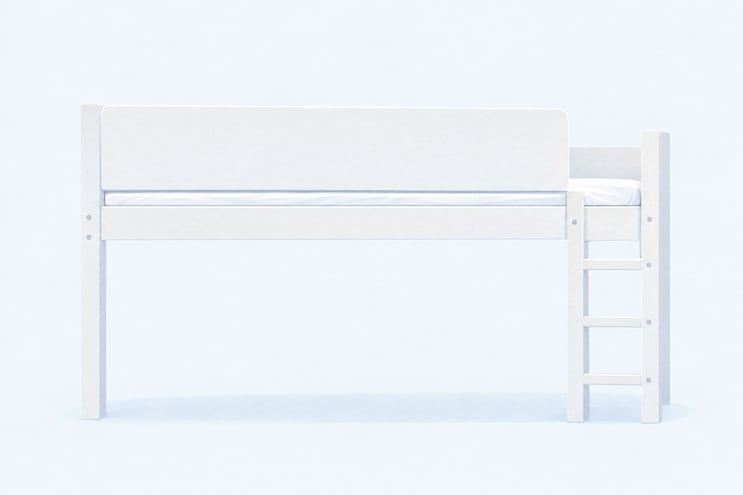 On a top bunk, buy to the maximum mattress depth the maker marks on the bed, however thin that looks.
Where to put a bunk bed in the room, and the rules on the ladder
Pick the wall before you build anything, because moving a finished bunk is a two-adult job with a lot of muttering, and nobody wants to do it twice. Jim's answer on handed-down bunks ended on exactly this: check where the bunk sits in the room so it isn't near any windows, light fittings or blind cords. His list for raised beds adds what to look for above and below the top bunk:
Deal with the windows first. In his first answers Jim said not to put a bunk next to a window, to reduce the risk of falls from the window and strangulation from any blind cords. The Child Accident Prevention Trust's page on falls from open windows says beds, sofas, toy boxes and other furniture near windows make it easier for children to climb up, and it suggests window restrictors or locks where you can fit them.3 For the cords, the charity's advice on blind cords and strangulation is that a cleat hook, or tying them up on a hook, gets them well out of a child's reach.4 Jim also said that strangulation can happen if cords, belts, bags or clothing are tied to the bed, so nothing gets tied to the frame or hung on it, dressing gown cords included. Set the room up in this order:
- Choose the wall. Away from windows, light fittings and blind cords, as Jim says, and clear of any shelf or picture that could fall onto the top bunk.
- Look up. Check for a ceiling light, a fan or a sloping ceiling near the top bunk, and that there will be room for your child to sit up without hitting the ceiling.
- Build it to the instructions. Every guardrail fitted, every bolt tightened as the instructions say, and the ladder fixed in place.
- Clear the floor. Nothing at the foot of the ladder or on the floor below the top bunk, and a clear route to the door.
- Deal with the cords. Blind cords tied up on a cleat hook, well out of reach, and nothing tied to the bed itself.
The ladder is where the house rules come in, and I'd go through them on the first night, while the bed is still a novelty and everyone is listening. Brief visiting cousins and friends as well, because a sleepover is when the rules get tested hardest. Jim's list for the climb is short enough to say out loud:
Bulky items is the one that gets forgotten. The water bottle and the toy they can't sleep without go up after your child does: hand them up once they're in bed, so both hands stay on the ladder. If there is a fall from the top bunk, the NHS guide to head injury and concussion says most head injuries are not serious, but it's important to get medical help for any symptoms.5 Its lists of when to call 999 or NHS 111 include these:
NHS: call 999 if someone has hit their head and:
- has been knocked out and has not woken up
- cannot stay awake or keep their eyes open
- has a fit (seizure)
- has fallen from a height of more than 1 metre or 5 stairs
- has problems with their vision or hearing
- has a black eye, but did not hit their eye
- has clear fluid coming from their ears or nose
- is bleeding from their ears or has bruising behind their ears
- has new numbness or weakness in any part of their body
- has problems with walking, balance, understanding, speaking or writing
- has a head wound with something inside it or has a dent in their head
- their behaviour has changed, like being more irritable or distracted, or losing interest in things around them
Get help from NHS 111 if you or someone else have recently had a head injury and:
- are being sick (vomiting)
- feel dizzy
- have any other symptoms you're worried about
Call 111 if you need advice for a child under 5 years old. Source: NHS, head injury and concussion.
When a child has outgrown the bunk bed, and the maker's weight limit
A bunk is outgrown when your child passes one of the maker's limits for it, or when the top bunk no longer leaves room to sit up. There's no birthday for it, and Jim's answer to the question went straight to the instructions:
He added that ceiling height is the other thing to think about, above all when someone tries to sit up in a top bunk. Children grow in jumps, and the first sign is often a bumped head on a Saturday morning. The same instructions cover older children and adults: the maker's limits apply to whoever is up there, so a grown-up cousin at Christmas, or a teenager with a friend sitting on the end, goes by the same maximum user weight as everyone else. If the weight isn't in the instructions you have, ask the maker. For the years in between, his list for raised beds has two lines I'd put on the fridge.
Regularly is the word that slides. Tie the check to something that already happens, like the start of each school holiday: try every bolt, give the guardrails and the ladder a firm push, and look along the frame for anything cracked or loose. Look at how your child fits the bed while you're at it. A head close to the ceiling when they sit up, or a weight creeping towards the maker's maximum, is the moment to start looking at the next bed.
Questions people ask about bunk bed safety
No. RoSPA recommends that children under six don't sleep on or use the upper bunk, and the Child Accident Prevention Trust agrees: its advice on staying safe on holiday reminds parents that children under six shouldn't sleep on the top bunk of a bunk bed.6 That goes for grandparents' houses and holiday lets as much as home, so pack the rule with the pyjamas.
Check it before you hand over any money, and again once it's built. Jim Oram's checks are that it complies with BS EN 747, that there's no damage to the frame, the guardrails or the ladder fixings, that it's assembled to the maker's instructions with loose bolts tightened, and that it gets a new mattress at the maker's size and depth. Get the make and model before you collect it, so you can find the instructions and search GOV.UK for any recall.
No thicker than the maximum the maker gives for that bed. Jim Oram's advice is that the limit is the maximum mattress thickness marked on that particular bed and in its instructions, never a guessed or general figure, because a mattress that is too deep reduces the effective height of the guardrail. If you're choosing one, our guide to bunk bed mattresses starts with the guardrail and the depth.
Only within the maker's maximum user weight and its other limits for that bed, which apply to an adult in the same way as to a child. Jim Oram's advice is to check the maker's instructions for age, weight and size limits before using a bunk bed, and to think about the ceiling height when sitting up in the top bunk.