You sleep on your side, and most mornings your lower back is stiff before you've even sat up, or one hip has ached half the night. A friend, or a physio, has told you to sleep with a pillow between your knees, and you've been wondering whether that's real or one of those tips people pass on because their aunt swore by it.
It's real, and the reason is simple. A pillow between your knees stops your top leg dropping forward in the night and twisting your pelvis and lower back round with it, and there's proper research behind the idea. It's a comfort change for how you lie, not a treatment. You can try it tonight with an old thin pillow, and as a side sleeper myself, it's the first thing I'd do before spending a penny.
Your top leg is the reason it helps
On your side, your top leg has nowhere to rest except forwards and down. Dr Ambreen Chohan, a senior research fellow at the University of Lancashire, answered our questions on side sleeping and back pain in October 2026, and this is how she explains it:
With nothing between your knees, your top knee slides forward until it lands on the mattress in front of you, and your pelvis rolls with it while your shoulders stay put. Your lower back is the bit in the middle that turns, and you hold that twist for hours without knowing. A pillow between your knees keeps the top leg up and level, so your hips stay stacked. Dr Chohan adds that research has long recommended a curled, foetal position for the same reason: to keep the lower back neutral. I think of the pillow as the thing that keeps the curl in place once you're asleep. My partner sleeps on their back and has never once had to think about where their knees go, which I find faintly unfair.
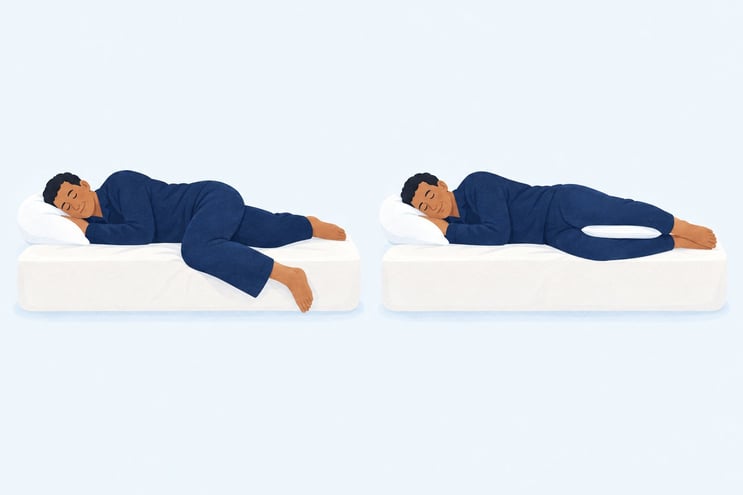 Left: with nothing between the knees, the top leg drops forward and the pelvis rolls with it. Right: a thin pillow keeps the top leg level and the hips stacked.
The research tested a purpose-made cushion, and it held up in a trial
A better angle at the pelvis is one thing, and a back that feels better is the part you care about. So Dr Chohan's group went on to put the cushion through a trial with people who had back pain, and she summed up the result:
I want you to know exactly where that comes from. Both studies were run by Dr Chohan's own research group, and both tested one purpose-made alignment cushion in adults with what doctors call mechanical low back pain. In the trial, 71 adults who'd had back pain for at least three months were split into two groups for four weeks: one group carried on with standard care, and the other had the same care plus the cushion. That's why I take the tip seriously. Research on knees and cushions will never make the evening news, and I'm glad somebody did it. It also means the pillow goes on top of whatever your GP or physio has already told you, and the NHS advice still stands: stay active, carry on with your daily activities, and do not stay in bed for long periods.
Start with an old thin pillow tonight
You can find out whether this suits you without buying a thing. Dr Chohan's advice for side sleepers is practical, and cheap:
The old thin pillow is her practical suggestion; the trial was about the purpose-made cushion. I'd still start with the pillow, because it costs nothing and you've almost certainly got one: the flat one at the back of the airing cupboard that you keep meaning to throw out. Thin is the point. You want your knees roughly hip-width apart with the top leg resting level, so leave the plump pillow from your bed where it is, since a fat one props the top knee higher than your hip. An NHS trust's lower back pain advice lists this among its comfortable positions: "Lie on your side with a pillow between your knees".1 To set it up:
- Lie on your usual side with your knees bent a little. A relaxed half-curl, the semi-foetal position Dr Chohan describes, suits this better than legs held dead straight.
- Slide the thin pillow between your knees. Your usual one stays under your head, and the thin one is only for your legs.
- Check your top knee. It should sit roughly level with your hip and rest on the pillow, with your knees about hip-width apart, instead of sliding forward onto the mattress.
- Take it with you when you turn. If you roll onto your other side in the night, move the pillow across too.
Fair warning: it will escape. Some mornings you'll find it on the floor or squashed down by your ankles, and that's no reason to give up on it. Put it back and settle the way you started; keeping a pillow between two knees all night is a faff for the first few nights.
Myth: you need a special knee pillow for this to work
Dr Chohan's own research is on a purpose-made cushion, and she still names an old thin pillow as a simple and inexpensive option. The job is holding your top leg up level, and an old pillow can do that. If you like the idea but the old one keeps going flat or wandering off, then a purpose-made cushion is worth a look.
Give it a fair run of nights before you judge it
Judging the pillow on night one is like judging new shoes in the shop. You're changing how you lie for hours at a time, so I'd give it at least a week, with the same setup every night so you're comparing like with like. These checks are about whether the pillow is doing its job, so tick them as you go:
- The pillow was still between your knees when you woke, or you put it back each time it went
- Your top knee rests on the pillow, not on the mattress in front of you
- The pillow is thin enough that your knees sit about hip-width apart
- You moved it across when you turned onto your other side
- You've given it at least seven nights in a row
- You've carried on with whatever your GP or physio already advised
The mattress matters too, for a different reason. A mattress can't hold your top leg up; what it changes is how far your shoulder and hip sink in when you lie on your side. My rule is a notch softer for a side sleeper than for a back sleeper, with a softer comfort layer over a supportive core so the hip sinks in a little. If your hip feels like it's resting on the floor, our guide to mattresses for side sleepers is the next place to look, once the pillow has had its week.
When to see a GP about back pain at night
A pillow changes how you lie, and that's all it's for. The NHS says back pain usually improves within a few weeks, and one of the reasons it gives to see a GP is pain that "does not improve after resting or is worse at night".2 Night is exactly when you'll be trying the pillow, so if the pain wakes you or gets worse when you lie down, book the appointment instead of spending weeks rearranging pillows. In many areas you may be able to get help, such as physiotherapy, from NHS community musculoskeletal (MSK) services without needing a referral from a GP.
NHS advice on back pain. Ask for an urgent GP appointment or get help from 111 if:
You have back pain and:
- you feel hot, cold, shivery or generally unwell
- it's severe pain that starts suddenly, or it's getting worse quickly
Call 999 or go to A&E if:
You have back pain and:
- pain, tingling, weakness or numbness in both legs
- a loss of feeling around your genitals or anus
- changes in your bladder or bowels, such as difficulty peeing, or peeing or pooing yourself
- changes in how your penis or vagina feels during sex, not being able to get or keep an erection, or not being able to orgasm
- chest pain
- it started after a serious accident, such as a car accident
Source: NHS, back pain.
Questions people ask about a pillow between the knees
Start with an old thin pillow. Dr Chohan suggests a supportive knee cushion or an old thin pillow, and the old one costs nothing. Pick one thin enough that your knees sit about hip-width apart, and move on to a purpose-made cushion only if it keeps going flat or sliding out.
You can try it. The same NHS trust leaflet lists lying on your back "with a pillow or two under your knees" as a comfortable position, alongside the side-lying one. Use the version that matches how you actually sleep.
Not for the pillow, because holding your top leg up works the same on either side. If one hip is sore, I'd lie on the other one so you're not on the sore hip all night, with the pillow between your knees either way.
See a GP if it's worse at night, if it does not improve after treating it at home for a few weeks, or if it's stopping you doing your day-to-day activities. Call 999 or go to A&E if you have back pain with numbness or weakness in both legs, or changes in your bladder or bowels.