If you're expecting a baby, or you've just brought one home, the cot mattress can feel like the one purchase you're not allowed to get wrong. Then you start reading boxes, and a good many of them say "breathable". It's a word that sounds as if it's about your baby's breathing, so the mattresses without it start to look like a risk. This is for the parent in the nursery aisle, or scrolling at midnight with a cold cup of tea, trying to work out whether that word should decide it.
It shouldn't, because a mattress isn't made safer by that word alone. "Breathable" describes the cover: it can let air and water vapour through, and that's what the word is telling you. What makes a cot mattress safer is a short list from The Lullaby Trust: firm, flat, an intact waterproof cover and the right size for your cot, with your baby on their back in a cot kept clear of everything else. If the mattress you like says breathable and passes those checks, buy it with a clear conscience. If it fails one, the word on the box doesn't make up for it.
What are you trying to decide?
- Which cot mattress to buy
- Whether to look for "breathable"
- Whether a hand-me-down is fine
- What can go in the cot with the mattress
- Raising the head end for reflux or a cold
A safe cot mattress is firm, flat, waterproof and the right size
The checks that matter are few, and you can do most of them with your hand and a tape measure. Professor Peter Fleming CBE, Emeritus Professor of Infant Health and Developmental Physiology at the University of Bristol, answered our questions about cot mattresses in November 2026. He has worked with The Lullaby Trust for many years, and he started exactly where the charity does:
Each of those is something you can check yourself. The Lullaby Trust's guide to baby mattresses and bedding says your baby's head should sink no more than a few millimetres into the mattress, so firm here means properly firm.1 Press the middle hard with the flat of your hand in the shop: you're feeling for a surface that barely gives and comes straight back. The same guide asks for a mattress that is completely flat, with no raised or cushioned edges or sides, and not sagging in places. The waterproof cover is there so you can wipe it and keep the mattress clean and dry, and intact means no rips or tears.
Size is the one I'd measure rather than trust. Cots aren't all one size, and the mattress has to fit the one you've got, so measure inside the cot, end to end and side to side, and hold those numbers up against the mattress size before you pay. Once it's in, run your hand round every edge and feel for any space between the mattress and the cot sides. The charity's wording for a good fit is "with no gaps", and that's the standard to hold it to. It also suggests checking the mattress meets the British Standard for cot mattresses, BS EN 16890, while being clear that a British Standard covers general safety, such as not falling apart or catching fire easily, and isn't a SIDS standard.
"Breathable" tells you how the cover handles air and moisture
"Breathable" describes the fabric of the cover, and Professor Fleming's answer on it was the most direct part of his reply. He sets out what the word does describe, then what it can't promise:
So the word describes the cover: air and water vapour can pass through it, and liquid usually can't. The walking-jacket comparison is the clearest way I've seen it put. A good waterproof jacket lets the damp from your skin out on a hill walk, and you still couldn't breathe through it if you tried. Professor Fleming adds that the word only really matters for spotting materials that let sweat evaporate, and that this isn't an issue for a sleeping baby in an appropriate thermal environment. Keeping a baby the right temperature is down to the room and the bedding. The NHS guide to reducing the risk of SIDS puts the room at about 16 to 20C, and says to take off a layer of clothing or bedding if your baby's skin is hot or sweating.2 Feel their chest or the back of their neck to check, and don't worry if their hands or feet feel cool, which the NHS says is normal.
Where your baby's breathing does come into it, the advice is about how they lie and what's around them. On their back, in a clear cot, with nothing soft that could end up over their face: that's what both the NHS and The Lullaby Trust put first. A breathable cover sits on top of all that and can't stand in for any of it. Whatever the label says, check the description also says the cover is waterproof, because that's the property on the safety list.
On a cot mattress, what does "breathable" tell you?
- That a baby could breathe through it if they ended up face down
- That the cover can let air and water vapour pass through
- That it lowers the risk of SIDS
- That it meets the British Standard for cot mattresses
It's a description of the cover. Professor Fleming explains that the surface can let air and water vapour through in certain conditions, and usually not liquid water, and that it does not mean a baby can breathe through it. The checks that keep a baby safer are firm, flat, an intact waterproof cover and the right size.
A second-hand cot mattress has to pass the same checks, and a few more
I'd buy a new mattress for each baby if you possibly can, and The Lullaby Trust recommends the same while saying plainly that it isn't always possible. Its reason is that some research has found a higher risk of SIDS with a second-hand mattress from outside the family home, although the link hasn't been proven. I slept for years on a hand-me-down that was already twenty years old when it reached me, so I understand the pull of a free one from family. A cot mattress for a baby is the one place I wouldn't take it on trust.
If you do use one, Professor Fleming's advice is that it must meet the same standards as a new mattress, with no tears or damaged areas on the cover. He also said how it has been kept matters, and that it should have been stored somewhere clean and dry. Ask whoever is passing it on where it has been, because a mattress that has sat in a damp garage or a loft can look fine from the top. The Lullaby Trust's page on second-hand baby products has its own list for a used mattress, and adds that second-hand items should come from a smoke and pet free home.3 Take the mattress out of the cot, put it somewhere with good light, and go through the list on both sides. Search "product recalls" on GOV.UK as well, which the charity suggests for any second-hand baby item.
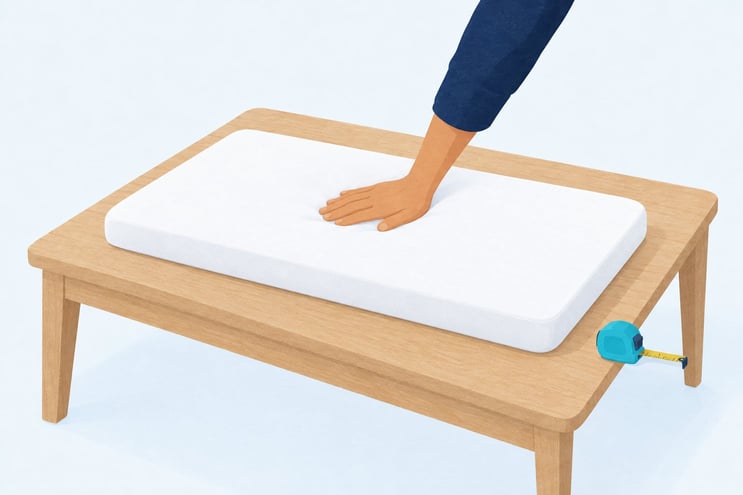 Press the middle hard with the flat of your hand: a firm cot mattress barely gives and comes straight back.
- The cover is whole, with no rips or tears
- The cover fits the mattress well and is waterproof all the way round
- No water marks or other water damage
- Firm: pressed hard in the middle, it barely gives
- Flat, with no sagging and no raised or cushioned edges
- It fits the cot with no gaps at the sides or ends
- It has a fire-resistant label on it
- It has been stored somewhere clean and dry
- It comes from a smoke-free and pet-free home
Nothing else goes in the cot: no nests, bumpers, pillows or wedges
A bare cot can look a little plain after months of picturing the nursery, and it's still the right way to set it up. The mattress, a fitted sheet and your baby is the whole of it. Professor Fleming was direct about sleep nests:
The Lullaby Trust's guide to baby sleeping products gives the reason. Pods and nests are soft with raised or cushioned sides, and a sleeping baby shouldn't lie on or have anything soft around them, particularly around their head, because it can make them overheat and increases the risk of SIDS.4 Soft material can also cover a baby's mouth and nose if they're pressed against it. The charity points out that there's a British Standard for cot mattresses and none for pods or nests as a place for a baby to sleep. If you've been given one as a present, keep it out of the cot. Professor Fleming went further on some of the other things that end up in cots:
Each of those has its own reason on The Lullaby Trust's pages. Bumpers become a risk once your baby starts to roll and move about, because babies can get tangled in the ties and fabric, or fall after pulling themselves up on them. Pillows can increase the risk of SIDS, and the charity lists pillows and duvets among the bedding to avoid. Wedges and sleep positioners are on its list of things to avoid, and it says there's no need for any equipment to keep a baby in one position unless a health professional has advised it for a specific medical condition. I know how many lovely things get given at a baby shower. Most of them are for the shelf, and that's fine. This is how the cot is set up for every sleep, day or night:
- On their back. Feet at the bottom of the cot, which is the feet-to-foot position.
- Bedding tucked in. Sheets and any blanket tucked in firmly and no higher than their shoulders, or a well-fitted baby sleep bag instead.
- Nothing soft or extra. Leave out pillows, duvets, quilts and sheepskins, and bumpers, pods, nests, wedges and sleep positioners.
- Toys out. Take soft toys out of the cot before each sleep, because they can cover a baby's mouth.
Keep the cot flat, even for reflux or a cold
Leave the cot level and the mattress flat, and don't prop up the head end. It's one of the first things people try when a baby is snuffly or bringing milk back up, and the kindness behind it is easy to understand. Professor Fleming's answer on it was clear:
The Lullaby Trust's page on the safest sleeping position says the same in its own words: don't incline, tilt or prop the mattress, the cot or your baby, because it doesn't help with reflux and is unlikely to improve cold symptoms.5 Its products guide adds that babies shouldn't sleep in anything that keeps them seated or inclined, as this can restrict their breathing. So keep books out from under the cot legs, and don't fold anything under the mattress to lift one end. The charity warns against putting folded blankets or a quilt under a baby on a thin travel cot mattress too, which is the same temptation in a different room.
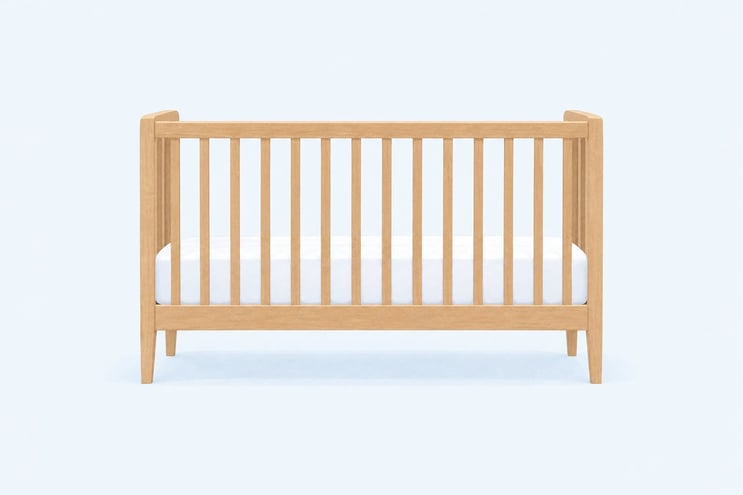 Level on the floor, flat mattress, fitted sheet, nothing else in the cot and nothing under the legs.
If your baby has reflux or any other health condition, the charity's advice is to speak to your doctor about the best care for them. If your baby's consultant or specialist neonatal team has told you to sleep them in a different position for medical reasons, follow their advice. Otherwise it's flat, on their back, every time. The NHS list below is the one I'd stick inside a kitchen cupboard door for the first few months:
NHS advice on reducing the risk of SIDS. Follow this advice whenever your baby is sleeping. Do:
- always place your baby on their back to sleep in the feet-to-foot position - this means with their feet at the bottom of the cot, Moses basket or pram
- move your baby onto their back if they roll (until they can roll onto their front and back again by themselves)
- place your baby in a separate cot or Moses basket in the same room as you for every sleep for at least the first 6 months
- use a firm, flat mattress
- keep your baby's cot clear of anything that could cover their face and head - do not use pillows, duvets, cot bumpers, loose blankets, soft toys or anything to keep your baby in place, like pods or nests
Don't:
- do not let your baby get too hot or too cold - make sure that your baby's room is between 16C to 20C
Source: NHS, sudden infant death syndrome (SIDS).
Questions people ask about breathable cot mattresses
Not because of the breathable label. Professor Fleming says the term has no relevance to the safety of a mattress: it describes a cover that lets air and water vapour through. The NHS and The Lullaby Trust put the risk-lowering steps elsewhere: a firm, flat mattress with a waterproof cover that fits the cot, your baby on their back, a clear cot and a room that isn't too warm. A breathable mattress that ticks those boxes is a perfectly good choice.
Turn them onto their back again until they can roll from back to front and back again by themselves; that's the NHS advice. The Lullaby Trust says that once they can do both on their own, they'll find their own sleeping position. Keep putting them down on their back at the start of every sleep, and keep the cot clear so there's nothing soft for them to roll against.
The Lullaby Trust recommends one, because you can wipe it down easily and keep the mattress clean. Put it under the fitted sheet, over a mattress that should already have its own waterproof cover, so you have two layers between your baby's nappy leaks and the filling.
The Lullaby Trust's advice is a new mattress for each baby where you can. If you can't, the research the charity mentions is about mattresses from outside the family home, and a mattress from your own still has to pass every check: whole waterproof cover, firm, flat, no sagging, no water damage, a fire-resistant label, a snug fit with no gaps, and stored clean and dry between babies, which is Professor Fleming's point. If you're buying new, our guide to cot mattresses is where I'd start.