It's two in the morning. The person you love is fast asleep beside you, snoring into the pillow with most of the duvet wound round them, and you're lying on the cold strip at the edge working out how many hours are left before the alarm. You've started thinking about the spare room. Then you feel awful for thinking it, as if wanting a decent night's sleep says something about the two of you. This one is for you.
No, sleeping apart isn't bad for your relationship in itself, and wanting to doesn't make you a bad partner. Chantal Gautier, an accredited sex and relationship therapist, says choosing to sleep apart doesn't mean you love your partner any less, and I agree with her completely. Where I come in is the shopping end. Two single duvets cost far less than a second bed, so I'd try the bed and the duvets first. If you have done all of that and still sleep better apart, move rooms without apologising to anyone.
Couples keep each other awake for ordinary, fixable reasons
Most of what wakes you is your bodies getting in each other's way, and very little of it has anything to do with how you feel about each other. Chantal Gautier is an accredited sex and relationship therapist and Senior Lecturer at the University of Westminster, and when she answered our questions about couples and beds in November 2026, her list of the usual reasons was refreshingly unromantic:
Go through that list and pick out the one that's yours. One of you runs hot and the other wants another blanket. One of you sprawls. One of you is up for the loo at three and the other wakes when the mattress dips. That's two different bodies sharing one duvet, and it's the bit nobody warns you about when you move in together.
Change the bedside-light habit tonight, because it costs nothing. If you wake and can't drift off again, The Sleep Charity's sleep FAQs say: "If you don't fall asleep within about 15-20 minutes, avoid watching the clock. Get up, move to another room, and do something quiet and relaxing, such as reading or listening to soft music." Take the book to the sofa and your partner never knows you were awake.1 Then pick what wakes you below for the first thing I'd try.
The first thing to try in your shared bed
- Heat or a stolen duvet, a few nights a month: two single duvets, each in the tog that suits its owner. It's cheap and it ends the tug of war.
- Heat or a stolen duvet, most nights: two single duvets tonight, then look at whether the bed is big enough for both of you, which is the next section.
- Tossing and turning, a few nights a month: two single duvets, so their turning stops dragging the covers off you, and give it a fortnight.
- Tossing and turning, most nights: look at the bed itself. A bigger bed, or a mattress that keeps a partner's movement to their own side, comes before a second bedroom.
- Snoring, a few nights a month: the NHS self-help steps further down, starting with side sleeping and the alcohol.
- Snoring, most nights: the NHS self-help steps, and if it hasn't improved or there's gasping or choking, a GP appointment with you there to describe it.
- Different bedtimes or the light, a few nights a month: whoever wakes gets up and reads in another room, not under the bedside lamp.
- Different bedtimes or the light, most nights: agree that the later one comes to bed in the dark, and talk about separate rooms on the nights that don't line up.
Try two duvets and the right bed before a second bedroom
Two single duvets on one bed is the answer I give every couple who asks me about this. My partner steals the duvet. Every night, without fail, they roll themselves up in it like a sausage roll and have no memory of doing it in the morning, so I'm speaking from the cold side. The Sleep Charity, in its piece on sleeping with your partner, says duvet hogging is a common grumble and that "In Scandinavia, many couples sleep with two single duvets on a double bed to keep both partners comfortable."
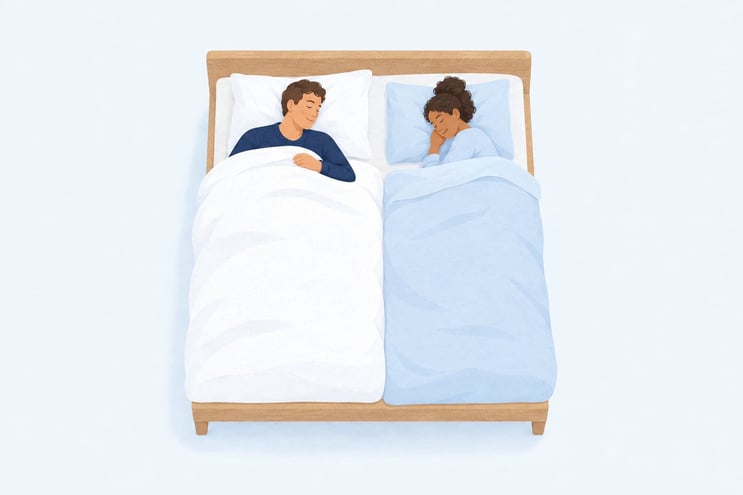 Two single duvets on one bed: each of you picks your own tog, and nobody wakes up uncovered.
Two duvets also mean each of you chooses your own tog, which settles the hot-and-cold argument without anybody giving in.2 I'll be straight about the look: your bed will look like a hotel that has run out of double duvets. By the third morning you won't care, and you can throw a blanket over the top when your mum visits.
Then look at the bed. The same Sleep Charity piece points out that "A double bed only gives each partner the same amount of space to sleep in as a cot", and I think about that sentence every time someone tells me their double is fine. If the room takes a king, go up a size. If it's the turning over that wakes you, the mattress counts for more than the size: I think memory foam is the best at keeping one person's fidgeting on their own side, and if you can't agree on firmness, a zip-and-link pair lets you each have your own and still share a bed. Sides are free to change, so put whoever gets up in the night nearest the door and the lighter sleeper on the far side. When you're ready to shop, our guide to mattresses for couples is where I'd start.
- Two single duvets on the bed, each in the tog its owner likes
- The one who gets up in the night sleeping nearest the door
- No bedside lamp for night-time reading: up and into another room instead
- A bed big enough for two, a king if the room takes one
- A mattress that doesn't pass every turn across to the other side
- The NHS snoring self-help tried for a few weeks
Snoring and restlessness need sorting where they start
When it's snoring or a partner who never keeps still, no duvet arrangement will fix it, and the person lying awake pays for it the next day. Gautier puts that cost plainly, and puts the relationship in the same sentence as the sleep:
"Take care of" is the part I'd hold on to, because snoring is something you can do something about together. My partner snores, the ordinary rumbling kind and nothing a doctor would worry about, and on a bad week the tiredness does more damage than the noise: short tempers about the bins, mostly. Treat it as a problem the two of you share, and it stops being an accusation.
The NHS says snoring is very common and not usually caused by anything serious, and that simple lifestyle changes can help stop or reduce it.3 Its list: try to lose weight if you're overweight, sleep on your side, don't smoke and don't drink too much alcohol. To stay on your side it suggests taping or stitching a tennis ball to the back of your sleepwear, which has to be the least romantic thing you will ever sew. It also suggests the snorer asks their partner to try earplugs. The Sleep Charity's FAQs agree earplugs can give short-term relief, and add that if snoring is loud, frequent or ongoing, it's important to take it seriously and seek advice.
If you do end up at the GP, go together. The NHS says it can help to bring someone to the appointment who can describe what your snoring is like, such as a partner, and you're the only witness there is. These are the signs it says need a GP:
NHS advice on snoring. See a GP if:
- lifestyle changes are not helping your snoring
- your snoring is having a big impact on your or your partner's life
- you feel sleepy during the day, your breathing stops and starts while you sleep, or you make gasping or choking noises while you sleep - you may have sleep apnoea, which can be serious if not treated
Source: NHS, snoring.
Sleeping apart doesn't mean you love each other any less
If you've sorted the duvets, looked at the bed and dealt with the snoring, and you both still sleep better apart, then sleep apart. Gautier's answer on this is the one I'd frame and hang on the spare-room door:
She asks why there should be a stigma, and I can't think of a good answer either. Her last sentence is the one to say out loud if you feel guilty: a good night's sleep can be good for the relationship as well as for you. The Sleep Charity, writing about couples who prefer to sleep apart, says choosing to sleep separately "certainly shouldn't be seen as a reflection of an unhealthy relationship", and that "it's quite sensible to sleep apart if your partner causes you disturbed sleep on a regular basis." Two separate people who wake up rested and like each other at breakfast are doing fine.
Give whoever moves a proper bed.4 A guest mattress that's fine for two nights at Christmas is a different job from one you sleep on every night of the week. A topper sorts out a lot of tired guest beds, and if the spare-room mattress has a dip you can see, it's due replacing anyway. Put the same thought into the room: blackout blinds, a duvet in the right tog, somewhere for a glass of water.
 If one of you moves, give that room a proper bed, a blackout blind and somewhere for a glass of water.
One check before you call it solved. If you move rooms and you're still lying awake, the problem may not have been the person next to you. The NHS page on insomnia lists stress, anxiety or depression, noise, a room that's too hot or cold, uncomfortable beds, and alcohol, caffeine or nicotine among the most common causes.5 It says to see a GP if changing your sleeping habits hasn't helped, you've had trouble sleeping for months, or it's affecting your daily life in a way that makes it hard to cope, and that a GP may offer cognitive behavioural therapy (CBT).
Talk about it in daylight, and keep a room for the two of you
The hard part is saying it, and Gautier's answer names the way in: open and honest conversations. Don't raise it at three in the morning, when one of you has just been elbowed and the other is half asleep and offended. Pick a Sunday morning with a cup of tea, and talk about sleep, because that's what this is about. Here's how to go about it:
- Start with you. "I'm not sleeping and I miss feeling human" goes down far better than "you snore like a tractor".
- What you've tried. Run through the duvets, the sides and the tennis ball, so they can see you wanted the shared bed to work.
- A trial run. Suggest two weeks and then a proper talk about how you both feel, with either of you free to change your mind.
- Agree what stays. Bedtime together, weekend mornings in one bed, whatever is yours as a couple: name it out loud.
That last step is the one people skip, and it's the one I'd spend longest on. Sleeping in different rooms changes where you sleep, and it doesn't have to change anything else. Gautier's thoughts on what a bedroom is for come from a separate answer about beds and intimacy, but they fit here too, because the room you share is worth keeping as somewhere you both want to be:
So keep the main bedroom nice for both of you: good sheets, a soft lamp, and the chair with all the clothes on it cleared for once. What I'd do is go to bed together, read or talk for a bit, and let whoever moves go when they're sleepy. Visiting each other's bed on a Saturday morning is allowed too, and I'm not the bedroom police.
Questions people ask about sleeping apart
Not in itself. Chantal Gautier, an accredited sex and relationship therapist, says choosing a "sleep divorce" doesn't mean you love your partner any less, and that a good night's sleep can benefit your relationship as well as your wellbeing. What she asks for is open and honest conversations about it. Try two single duvets and a bigger bed first, because they cost less than a second bed, and agree what you'll keep doing together before anyone moves.
Yes, and it's nothing to be ashamed of. The Sleep Charity says choosing to sleep separately shouldn't be seen as a reflection of an unhealthy relationship, and that it's sensible to sleep apart if your partner disturbs your sleep on a regular basis. Gautier asks why there should be a stigma around it at all. If you're both sleeping better and still making time for each other, that's working.
Raise it in the daytime, start with how you're sleeping rather than what they do, and say what you've already tried in the shared bed. Suggest a two-week trial so neither of you feels it's final. Then agree what stays the same, such as going to bed together or weekend mornings, so the conversation is about sleep and not about the two of you.
They help with heat and duvet theft. Each of you gets your own tog and nobody wakes up uncovered. The Sleep Charity says many couples in Scandinavia sleep with two single duvets on a double bed to keep both partners comfortable. It won't fix snoring or a partner who turns over all night; for those, look at the NHS snoring advice and the bed itself.