The baby shower is over and the sofa is covered in soft things: a sleeping bag with a hood and little bear ears, a padded nest a friend swore by, a cushion that promises to help your baby settle. Or it's 3am, the baby is finally down, and you're scrolling listings for anything that might buy you another hour. If you're looking at that pile and wondering which of it belongs in the cot, start with the sleeping bag.
Whether a baby sleeping bag, or sleep sack, is safe depends on the bag, and you can usually see the difference before you open the packet. The government's product safety office, OPSS, issued an alert on baby sleeping bags in October 2026 that says not all of them are safe, and to only buy or use one with arm holes and no hood.1 Jim Oram of RoSPA adds the British Standard, BS EN 16781, and the right size for your baby. Most of the rest of the pile stays out of the cot. Jim's list of what goes in is short: a firm, flat, waterproof mattress, and a well-fitting sleeping bag or a securely tucked-in blanket.
Baby sleeping bags: armholes, no hood and the right size
Armholes and no hood are the two checks you can make from across the room, and they're the two the OPSS alert is about. Jim Oram is Policy Officer for Home Safety at RoSPA, the Royal Society for the Prevention of Accidents, and he answered our questions about baby sleep products in November 2026. On sleeping bags he gave the whole list in one sentence:
OPSS gives its reasons for the armholes and the hood in the alert. Without armholes to hold a baby in position, a baby may slip down into the bag, and the material may cover their nose and mouth. A hood may do the same as the material moves. Materials that hold heat in or enclose a baby's head stop heat escaping, and OPSS points out that the risk of sudden infant death syndrome (SIDS) is higher if a baby overheats. The alert doesn't apply to bags that meet BS EN 16781:2018, the voluntary standard for children's sleep bags used in a cot. Look for that number on the bag, its packaging or the listing.
I'll admit the hooded ones with ears are the sweetest thing in any gift pile. For sleep, I'd pick the plain one with armholes and no hood every time.
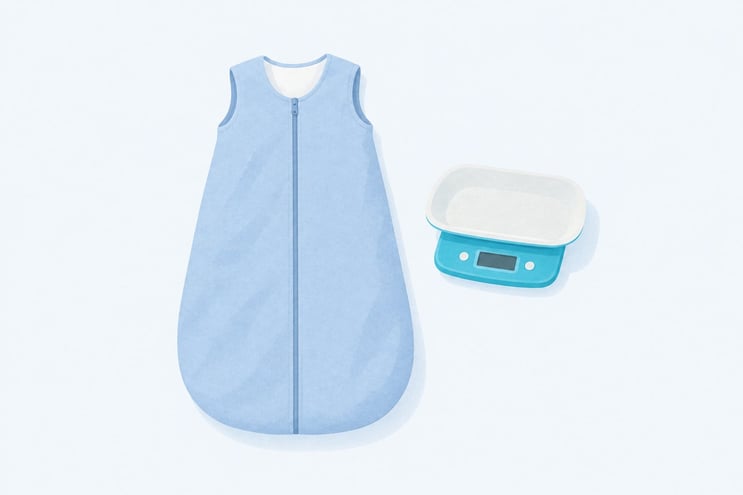 Armholes and no hood: the two things you can check before the bag is even out of the packet.
The right size is the part people guess. The Lullaby Trust's page on how to dress your baby for sleep says most baby sleeping bags are fitted by weight, not age, so go by the weight on the maker's size guide rather than the months on the front of the pack.2 It should be well fitted around the neck and shoulders, so your baby can't wriggle down inside. The charity says not to add blankets on top of a sleeping bag; if your baby feels cold, add a layer of clothing or choose a higher tog bag. It doesn't recommend weighted sleeping bags for babies under one, because of the risk of overheating and head covering, and because they can restrict breathing by pressing on a baby's chest.
Weigh your baby before you order the next size up. It's a small faff, and it saves sending a bag back. These are the alert's own words:
OPSS Product Safety Alert: Baby Sleeping Bags.
- Not all Baby Sleeping Bags are safe
- Only buy or use a baby sleeping bag that has arm holes and no hood
- Do not buy or use a baby sleeping bag that lacks armholes or which includes a hood.
- If the product was marketed for unsupervised baby sleep, you should contact the business that supplied the product; you may be entitled to redress under the Digital Markets Competition and Consumers Act 2024.
Source: Office for Product Safety and Standards, Product Safety Alert PSA9.
Why baby sleep products keep turning up in safety warnings
A sleeping baby needs very little, which is hard to believe when so many packs promise a better night. Jim's answer on why these products keep appearing starts with that promise:
OPSS says it has published nearly 50 recalls or product safety reports for dangerous baby sleeping bags since 2023. In December 2025 it issued a separate alert on baby sleep pillows, which it says have been linked to child deaths in the UK and overseas, and which shouldn't be used for babies under 12 months or placed in a cot or crib. That alert lists other names the same thing goes by, among them baby comfort cushion, baby cuddle cushion, baby hug pillow and baby sleep cushion.3 If you're searching for something to help a baby settle, those are the words I'd stop at.
The Lullaby Trust's guide to choosing baby sleeping products gives the reasons in plain terms: a baby's face can press against soft items such as loose bedding and pillows, which can block their breathing, and anything that keeps a baby seated or inclined can restrict it too.4 The claims printed on a box are harder to weigh up when you're tired, and the charity answers two of them:
"No baby has ever died of SIDS while using this product."
The Lullaby Trust says that doesn't mean a product is safe or safer. With the number of babies dying of SIDS in the UK now thankfully very low, the charity explains, the claim doesn't prove one product is safer than others.
"It meets a British Standard, so it lowers the risk of SIDS."
The Lullaby Trust says there is no safety standard related to SIDS. A British Standard is about general safety, for instance a product that won't fall apart or easily set on fire, and the charity still encourages you to buy products that carry one.
What a clear sleep space looks like
I know a bare cot isn't the picture anyone pins to a mood board, but a mattress and your baby's bedding really is the whole of it. Jim's answer was short:
Use a bag or a blanket, one or the other. The Lullaby Trust's page on keeping a clear cot says babies need just two items in their cot, a firm, flat, waterproof mattress and lightweight bedding.5 Lie your baby on their back with their feet at the foot of the cot, so they can't wriggle down under the bedding. The charity's safer sleep advice, which is where Jim points parents for more, applies to every sleep, day and night, until your baby is 12 months old, or 12 months after their due date for premature or low birth weight babies. If you're still choosing the mattress, Professor Peter Fleming's answers on whether a breathable cot mattress is safer cover that part.6
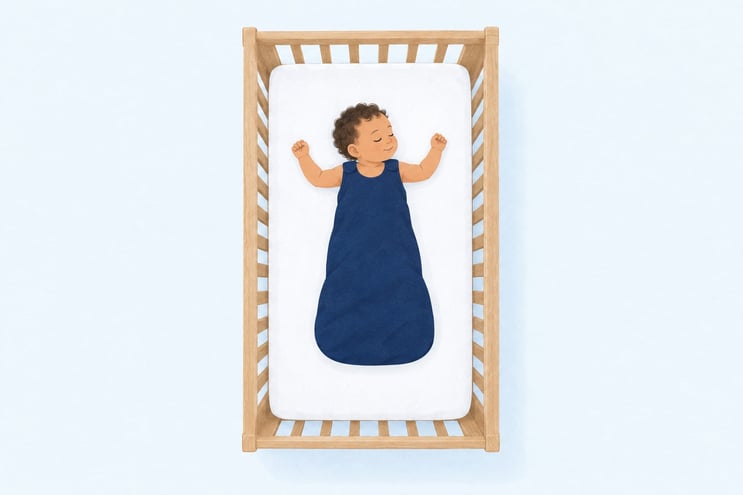 On their back, feet at the foot of the cot, a well-fitting sleeping bag and nothing else in there.
Jim also gave a list of what to leave out, and most of it is soft:
Cushions that pat a baby to sleep are sold as soothers, and we've written up an OPSS report on a baby pillow with a patting function among the recalls on this site. Jim's list puts them with the other comfort and soothing products. Nests and pods look so cosy that I can see why they're hard to give up, and The Lullaby Trust advises against them as sleep spaces because of those soft, raised sides. If any of this came as a present, thank whoever gave it and keep it out of the cot. The charity's page on second-hand baby products suggests looking up anything you're gifted, which is also a polite way round a friend who swore by something.8
What to check before you buy a baby sleep product online
There are two checks, and you can do both on your phone before you pay: the British Standard and the recall list. Jim's advice covers both:
For a sleeping bag, that's the BS EN 16781 Jim names. The Lullaby Trust lists the others on its products page, including BS EN 716-1:2017 for cots and travel cots and BS EN 16890:2017+A1:2021 for cot mattresses. If you can't find the number on the product page, ask the seller before you buy, and if they can't tell you, I'd keep scrolling. The OPSS product safety alerts, reports and recalls page has a search box, and filtering by childcare articles and children's equipment narrows it down.7
I scroll listings in bed until I crash out with the phone still in my hand, so I know how easy it is to buy something at midnight on the strength of a nice photo. For anything second-hand, the charity strongly recommends a British Standard too, above all if you buy online, and says used items should come from a home without smokers or pets. Run through this before you pay:
- It has armholes
- It has no hood
- BS EN 16781 is shown on the bag, the packaging, the instructions or the listing
- The size guide goes by weight, and your baby's weight is inside it
- It isn't weighted
- You've searched the OPSS recalls page for the product name
- It's new, or it comes from a home with no smokers or pets
If something you own is recalled or named in a warning
Stop using it today, even if your baby has slept in it for weeks without a problem. Jim kept this one brief:
OPSS gives you a second route. Its sleeping bag alert says that if the product was marketed for unsupervised baby sleep, you should contact the business that supplied it, and you may be entitled to redress under the Digital Markets Competition and Consumers Act 2024. So you can go to the maker, as Jim says, or to whoever sold it to you. OPSS notices list details that identify the product, such as the name it was sold under and a listing or product number. Compare those with your order before you write. Keep the order email and a photo of the label together in one place. When you're running on three hours' sleep, that's the bit you'll be glad you did. In order:
- Stop using it. Take it out of the cot tonight, before you go looking for the receipt.
- Match it to the notice. Check the product name and numbers in the OPSS notice against the label or your order.
- Contact the maker or the seller. Ask for a refund or a replacement, and mention the OPSS notice by its number.
Questions people ask about baby sleeping bags
The Lullaby Trust calls baby sleep bags a good option for safer sleep, because they help stop a baby wriggling down under covers and getting their head covered. For a newborn the OPSS advice still applies: armholes and no hood. Check your newborn's weight against the maker's size guide, because most bags are fitted by weight. Make sure the bag fits well around the neck and shoulders so they can't wriggle down inside.
The one the maker's tog guide gives for your room temperature. The Lullaby Trust explains that it can't give one chart for every bag, because materials and layers change how warm a bag is. A lower tog suits a warmer room, a higher tog a cooler one. The NHS advice on reducing the risk of SIDS is to keep the room at about 16 to 20C with a room thermometer, and to check your baby's temperature by feeling their chest or the back of their neck.9 Don't double up. The charity says two 1 tog bags don't make a 2 tog, and that the air trapped between the layers adds warmth, which can be dangerous.
The Lullaby Trust's answer is no. The charity advises against them for sleep because their sides are soft and raised or cushioned, and cot mattresses have a British Standard while nests and pods, as somewhere for a baby to sleep, have none. Jim lists padded sleep pods and baby nests among the things not to use.
Search the product name on the OPSS recalls search page on GOV.UK, and filter by childcare articles and children's equipment. If you find a notice, match the details in it against your label or order before you contact the maker or the seller.