You've come home from the sleep clinic with a machine, a mask and a length of hose, and tonight you're meant to sleep attached to all three. The mask feels odd on your face, and you can't work out where the tube goes when you roll over. The person beside you may be lying awake too, listening to the machine after months of listening to the snoring and the pauses. This is for both of you.
So how do you sleep with a CPAP machine? Much the way you sleep now, on your side or your back, with a few changes to how the bed is set up. Put the mask on as soon as you lie down for the night, and fit it lying in the position you sleep in, with the straps no tighter than they need to be. If you sleep on your side, lift the mask clear of the pillow so it isn't pushed off your face, and run the hose so it moves with you when you turn. It can feel strange at first, and when something isn't working your sleep clinic and the Sleep Apnoea Trust are there to help.
What's giving you the most trouble at the moment?
- The mask feels claustrophobic
- Dry mouth or air leaking
- Sleeping on my side with the mask
- The hose gets in the way
- I'm the partner and I've got questions
- Going away with it
Getting used to CPAP: fixes to try before you give up
A rough start doesn't mean CPAP isn't for you, and the usual early problems have fixes worth trying before you give up. Claire Allen, Managing Secretary of the Sleep Apnoea Trust, answered our questions about sleeping with CPAP in November 2026, and she began with how differently people take to it:
Take those one at a time, because each has its own fix. Claire points anyone having trouble to the Trust's page of frequently asked questions from patients.1 Claustrophobia is one of the reasons that page gives for people pulling the mask off in their sleep, and one of its fixes is wearing the mask for 20 to 30 minutes while you're awake, which it says helps your brain accept it as non-threatening. I'd do that on the sofa with the telly on, where nothing is riding on it. For a dry mouth, it says the cause could be your mouth not closing properly and that a chin strap can help keep it closed. It also suggests drinking from a sports bottle with a nozzle, so you don't have to take the mask off. For air leaking into your eyes, the advice runs against instinct: don't over-tighten the straps, because the cushion needs room to inflate and seal.
If you've tried all that and you're still fighting it, don't sit on it for weeks. The NHS says to tell your doctor if you find CPAP uncomfortable or hard to use. Claire's advice is to contact your sleep clinic, which may have its own online resources too, or to write to the Trust's email helpline.2 It works through a form that asks about your clinic, your machine, your mask and when you started, so have those to hand before you sit down with it. Forms are a faff, I know, but the detail is what lets them help.
As for why people stick with it through the strap-fiddling and the dry mornings, Claire's answer is the one I'd keep in mind on a bad night:
I'd put up with a lot of fiddly nights for sleep like that. The NHS puts the rule plainly: CPAP may feel strange or awkward at first, but try to keep using it, because it works best if you use it every night. That means the nights you'd rather not, too. The Trust's FAQ says to start the machine as soon as you lie down ready for sleep, and if you wake in the night, preferably to keep the mask on so it's working when you drift off again.
Side sleeping with CPAP: lift the mask off the pillow
You can sleep on your side with a CPAP mask, and for some people it's the better position anyway. The trick is a pillow set-up that leaves the mask some room. Claire told us some people find pillows help with where the tube sits, and others use pillows or other positional aids to stay on their side. She added that side sleeping can help sleep apnoea even without CPAP for some people: the ones whose snoring or pauses in breathing happen only when they're on their back. The Trust explains this under positional therapy, which it describes as encouraging side sleeping, with pillows and wedges among the aids. Keep using your machine and ask your sleep team whether that applies to you, because they can advise from your sleep study results.3
If you sleep on your back, you don't have to retrain yourself. The Trust's FAQ says to sleep whichever way is most comfortable, and notes that a slightly higher pressure may be needed on your back, so if that's how you spend most nights, ask your clinic whether your pressure is set for it.
I sleep on my side, so this is the bit I'd fuss over. On your side, the mask ends up between your cheek and the pillow, and the Trust has a simple answer for a pillow that pulls the mask off your face: a neck pillow to raise the mask clear of the pillow. To my mind the pillow under your head should be high enough to fill the gap between your shoulder and your ear, so your head sits level. Too flat, and your face sinks in, mask and all. Try what you already own at that height before you buy anything.
Myth: you need a special CPAP pillow
The Sleep Apnoea Trust's FAQ says there is no evidence, guidance or standards for manufactured pillows that claim to help or cure sleep apnoea, and that you may find them more comfortable, or you may not. Cut-out pillows are a comfort choice. Sort the height of the pillow you've got and try a neck pillow first, and if the mask still ends up shoved sideways, a cut-out one is worth trying for comfort.
Fit the mask in bed, lying the way you sleep, so you're sealing it in the position it has to work in all night. The Trust's FAQ sets out this order:
- Sit on the bed. Turn the machine on and put the mask on with the straps loose.
- Lie down in your sleeping position. Head on your pillow, the way you'd normally sleep.
- Tighten slowly. Pull the straps only until you get a good seal, and stop there.
- Seat a dual cushion. If your mask has one, gently pull the mask straight out from your face so the cushions inflate, then lay it back.
You should be able to tell by feel when the seal is comfortable. If you find yourself tightening the straps harder and harder to stop a leak, and it's leaving sore marks, the Trust suggests a different mask may suit you better. Ask your sleep clinic to check the fit before you put up with it.
Where the CPAP machine and hose go in bed
Put the machine on your own side of the bed, on your bedside table, so the hose never has to cross your partner. That's my view rather than anyone's guidance, and so is the next one: if the hose ends up under your shoulder every time you roll, try running it up and over the headboard so it comes down to you from above and moves when you do. A headboard is for sitting up against, in my book, and I reckon it makes a decent hose rail too. If the air feels cold, the Trust's tip is to run the hose under the covers to keep the air warm. Its travel advice also suggests a mat under the machine, because bedside furniture can amplify the noise if it isn't padded, and that's as true at home as in a hotel. I'm a light sleeper, so I'd put one under it from the first night. Pick a mat that won't be affected by heat, because the Trust notes that some machines get warm in use.
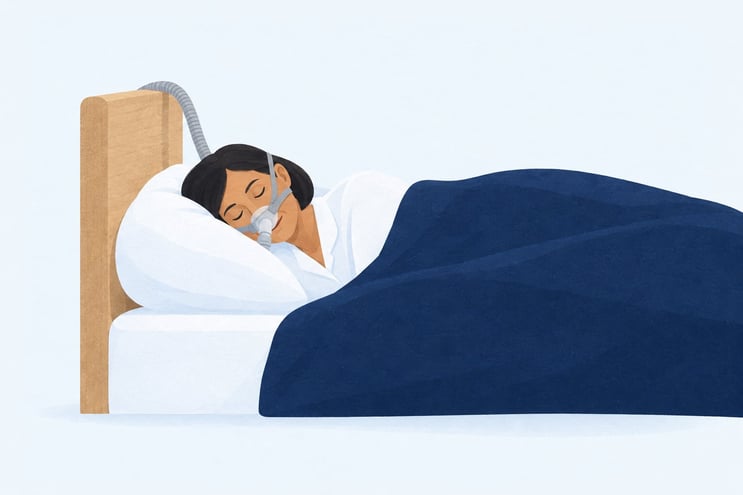 A pillow high enough to keep your head level, and a small neck pillow under the jaw, keeps the mask off the pillow; the hose comes in over the headboard.
What partners ask about CPAP: mask fit, driving and power cuts
If you're the partner, you've been living with this too. The NHS says sleep apnoea can be difficult for a partner and put a strain on the relationship, so your questions count. Claire listed the ones partners bring to the Trust:
Mask fit first, because you may notice a problem before the person wearing it does. If you can hear air hissing out round the mask or feel it blowing on your side of the pillow, tell them. I'd mention it in the morning, when nobody's half asleep. If it keeps happening, the clinic can check the fit, and the Trust's FAQ page has a whole section on using CPAP for the two of you to read over a cup of tea.
Driving is the one with legal weight behind it. The GOV.UK page on excessive sleepiness and driving says you must tell the DVLA if you have confirmed moderate or severe obstructive sleep apnoea syndrome with excessive sleepiness.4 The same goes for any other sleep condition that has caused excessive sleepiness for at least three months, including suspected or confirmed mild OSAS. You must not drive until you're free from excessive sleepiness, or until your symptoms are under control and you're strictly following any necessary treatment. Not telling the DVLA about a condition that affects your driving can mean a fine, and you may be prosecuted if you're involved in an accident as a result. If you're not sure whether your sleepiness will affect your driving, GOV.UK says to ask your doctor. And if you've seen them drowsy behind the wheel, say so, and ask them to tell the doctor.
NHS advice on driving and sleep apnoea.
You may need to tell the DVLA about your sleep apnoea.
If sleep apnoea with excessive sleepiness has been confirmed, you must not drive until symptoms like feeling very tired are under control.5
Source: NHS, sleep apnoea.
CPAP doesn't give you oxygen, and it isn't life support
The power-cut question gets easier once you know what the machine does. The NHS describes it as a machine that gently pumps air into a mask while you sleep, to stop your airways getting too narrow. I can see why it gets taken for more than that: a mask and a humming box at the bedside look like something from a hospital ward. Asked for the misunderstanding the Trust hears most, Claire gave this one:
So if the power goes off at two in the morning, most people will tolerate a short break in treatment, and the price may be feeling sleepier the next day. After a broken night, be honest with yourself about the drive to work. In her earlier answers for us this autumn, Claire's advice was to make sure you're safe to drive, and if you feel sleepy while driving, to stop straight away. Ask your sleep clinic if you'd like a plan for longer cuts, because they know your machine and your settings.
Travelling with CPAP: keep it in the cabin and pack an extension lead
A night away doesn't mean a night off the machine. Claire's travel advice was short and practical:
That extension lead is the tip I'd underline. In hotel rooms and spare rooms the only free socket is often on the far wall behind a wardrobe, and you find that out at eleven at night. The Trust's FAQ suggests 5 metres of lead for home and 10 metres to cover most hotels, with a towel over the cable wherever you might walk across it in the dark. Staying with family is the same job without the airport; the Trust's practical guide says the problems at friends' houses and hotels can be surprisingly similar.
For flights, GOV.UK's hand luggage rules list CPAP machines as medical equipment you can carry in hand luggage, and say medical equipment is screened separately at security.6 Using the machine on board is another matter: the Trust says airlines vary widely on it. Its travel section has a practical guide and an airline guide that sorts airlines by whether they allow CPAP on board, so check yours there before you book, and contact the airline well ahead of the flight.7
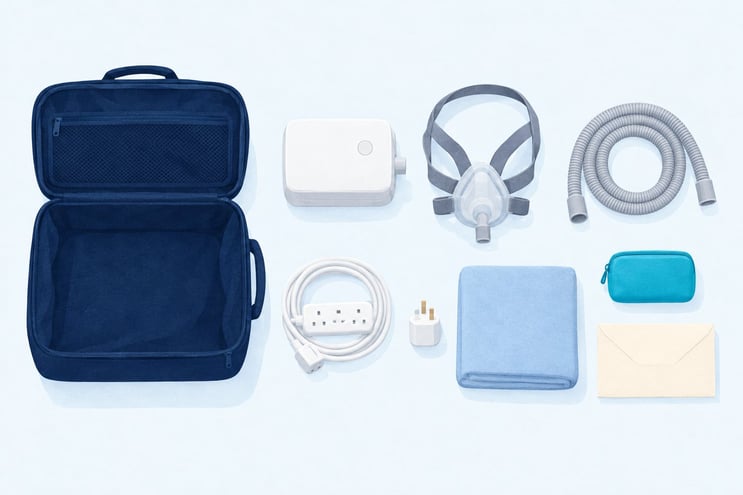 Everything in the cabin bag, including the lead you will need when the socket is on the wrong side of the room.
Packing for the first trip is where things get forgotten, usually the lead, because it's still plugged in behind the bedside table at home. Run through this the night before:
- Machine, mask and hose packed in your hand luggage, not the hold
- An extension lead, around 10 metres for a hotel
- A letter from your sleep clinic about the machine, for check-in and security
- A travel adapter if you're going abroad
- A mat for the machine on a strange bedside table
- Your airline's CPAP rules checked before you fly
- Your travel insurer told that you have sleep apnoea
That last one is easy to skip. The Trust's practical guide warns that if you don't tell your travel insurer you have sleep apnoea, you may find your policy isn't valid, and it can take time to sort out, so do it when you book.
Questions people ask about sleeping with CPAP
Whichever is most comfortable for you, according to the Sleep Apnoea Trust's FAQ. Side sleeping can help some people whose breathing problems happen only on their back, while on your back you may need a slightly higher pressure, which your clinic can check. On your side, the Trust suggests a neck pillow to raise the mask clear of the pillow. If you're choosing a new bed as well, our guide to mattresses for sleep apnoea covers the bed itself.
It varies from person to person. Claire Allen of the Sleep Apnoea Trust says some people have no problems at all, while others struggle with claustrophobia, dry mouth or air leaks. The NHS says it may feel strange or awkward at first and works best used every night. If it's still hard going, tell your sleep clinic or your doctor before you put it back in the box.
Yes, in your hand luggage. GOV.UK allows CPAP machines in hand luggage as medical equipment, and the Sleep Apnoea Trust says to keep yours out of the hold and carry a letter from your sleep clinic for security. Check with the airline before you book, because using it during the flight is up to them.
You must if you have confirmed moderate or severe obstructive sleep apnoea syndrome with excessive sleepiness, GOV.UK says. You must also tell it about any other sleep condition that has caused excessive sleepiness for at least three months, and that includes suspected or confirmed mild obstructive sleep apnoea syndrome. You must not drive until you're free from excessive sleepiness, or until your symptoms are under control and you're strictly following any necessary treatment. Ask your doctor if you're not sure whether your sleepiness will affect your driving.