If you've lain on a Sealy at Dreams, liked how deep and plush it was, and wondered whether the dearest Posturepedic Elevate is worth the money, this is the one you're asking about. The Merivale sits at the top of the four Posturepedic Elevate mattresses Sealy sells through Dreams, and it's the only one graded Medium Firm, where the Sandridge is Firm and the Gladesville and Denison are Very Firm. It's the rung for people who want Sealy's cushioned build without the hardness of the rungs below it. You sink through a soft fibre top and a thick run of foam before the coil underneath pushes back, and the bed stays steady right out to its edge. Our tester liked it on their back in a Dreams store in March 2024, and there's a fair bit here I like too.
The catch sits under all that foam. AlignSupport, the coil unit inside, is Sealy's own spring system, twice tempered for strength, and it supports you well. Its springs are linked together as one unit, though, not each sewn into a pocket of its own, so when your partner rolls over, the movement travels across to your side. It's the complaint that keeps coming up from unhappy owners, and one of them was told by Dreams that it comes down to "one big sheet of spring". I'm a light sleeper who wakes at the smallest thing, and on this bed I'd be up every time my partner turned over.
Best for one sleeper, or two who lie still
Our tester is a combination sleeper, a little over ten stone, and spent their time on it lying on their back and switching between positions. They found a thick layer of cushioning under the lower back, and the support kept up with them as they moved. It felt cool to lie on, which pleased someone who finds some mattresses a bit warm. The edges felt stable enough that they used the whole length of the bed without worrying about the end.
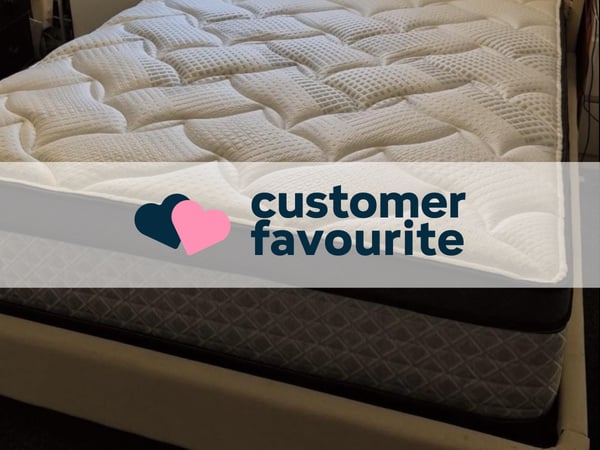
So it suits back and combination sleepers of around average weight who sleep alone, or next to someone who barely moves. My starting point for almost anybody is Medium Firm, and "firmer is better for your back" is a myth I'll argue with anyone, so I'm glad Sealy made one Posturepedic Elevate bed at this grade. Combination in the name is Dreams' word for springs with foam on top and says nothing about how you sleep. Combination sleepers do get on with it, though, because the one memory foam layer sits a few layers down, under the fibre and a contour foam, so it doesn't grip you when you turn.
Don't buy it if you wake easily and share a bed with a restless sleeper, because the linked springs pass every turn across to you. If you're slight and sleep on your side, pass too, because a light shoulder never sinks far enough into Medium Firm to stop it aching by morning. Dreams' own staff put the limit at 18 stone per sleeper, so anyone heavier needs a firmer bed built for the job.
Eight of its eleven layers sit above the springs
Count down from the top of its 33cm and you pass eight layers before you reach the coil. In order, you get a soft fibre surface, a cool-touch cover fabric and an anti-allergy treatment, then a contour foam, a graphite-infused memory foam, a plant-based foam set under the hips and lower back, a firm foam and a double layer of medium foam. Then comes the coil, with Sealy's UniCased border round it and a board called BasePlank underneath.
Graphite helps foam shed a little heat, and I count it as a mild plus that I'd never buy a bed for. Memory foam still holds warmth whatever goes into it, so if you overheat badly, look for springs with less foam on top. Deep mattresses are often padded out with cheap foam, and I always want to know how thick each comfort layer is before the total impresses me. Here the foam is the whole story, because every step up the Posturepedic Elevate range at Dreams adds foam and leaves the springs alone. It gives you a lovely sink on the shop floor. It does nothing about the springs, and the springs are what carry your partner's movement to your side.
One grade softer than the Sandridge, on the same springs
Put it beside the Sealy Posturepedic Elevate Sandridge Combination Mattress, the rung below, and the springs, the border, the cover and the guarantee are the same. The Merivale adds 3cm, a contour foam layer and a separate firm foam, and it uses medium foam where the Sandridge has firm and extra firm, which takes it one grade softer. Below those two sit the Very Firm Sealy Posturepedic Elevate Gladesville Combination Mattress and the Sealy Posturepedic Elevate Denison Combination Mattress, which has a pillow top I'd steer anyone away from.
The springs stay the same all the way up the range, so the extra you pay for the Merivale buys softness and depth and nothing structural. If Medium Firm is the grade you need, that softness is worth having, and this is the only Posturepedic Elevate bed at Dreams that gives it to you. If Firm suits you, the Sandridge is the same idea for less, and at that money I'd still buy pocket springs.
The edge is the best thing about it
Sealy's UniCased border runs round the coil, and it does what Sealy says it will. Owners who sit or lie right on it find it doesn't dip, even on a mattress this tall, and close to the side they don't feel they're about to roll off. Our tester found the same. Two people on a double use every inch of it, so a border that keeps its shape is worth a lot here, and on a hybrid I look at the border before anything else. This one is excellent.
Sit on it to get in and out as much as you like, just don't turn it into a sofa. Dreams' own care advice says long spells on the edge strain the frame round the springs and can make it sag over time.
Medium Firm on the label, firmer once it's home
Owners keep calling it firmer than they expected, some for the first few weeks and some for good, and I couldn't find one calling it too soft. I trust owners over a printed grade every time. One summed it up as "firm but doesn't feel hard", which is a fair picture of how it settles under most bodies. The display model has been softened by every shopper who tried it before you, so ten minutes on it tells you what to rule out and very little about how yours will feel in its first month.
If it stays too firm, Dreams' 100-Night Comfort Guarantee is your way out. It swaps the mattress once, no earlier than a month in, for a charge, and it gets you a different bed from Dreams rather than your money back. One owner swapped theirs inside the window and loved the replacement. Keep a protector on it from the start, or Dreams can refuse the swap. I'm not a fan of protectors, because they stop air moving through the top of a bed, but Sealy asks for a breathable one, so buy that kind.
33cm deep, one-sided and a two-person job to move
At 33cm it's deeper than an ordinary fitted sheet will stretch to, so buy deep-pocket sheets with the mattress. It has only one sleeping face. A bed you can flip lasts longer. I think building just one good side is kinder to the factory than to you. A double weighs 33.8kg and Sealy's own instructions assume two people for handling it, so rotate it as a pair.
Check the base before you blame the mattress for a dip. Sealy wants slats about 10cm wide with gaps of no more than 7.5cm, which is almost exactly my own rule of thumb, so measure yours before delivery day. Sealy also does something I wish every maker did: it says any settling under 32mm is normal, which tells you the depth at which a dip becomes a fault worth claiming for. One owner saw dipping at three months and was told it was normal. Get a ruler across it, and if it passes 32mm, go back to Dreams, because claims start with the shop.
Sealy's own coil, at a price that buys pocket springs
Sealy doesn't excite me as a brand, and the name on this one makes me smile: Sealy Posturepedic Elevate Merivale Combination is five words before you reach the word mattress. That's my taste talking. Posturepedic is a long-established spring system, and Sealy works on it with an advisory board of orthopaedic surgeons and engineers, which is more than most labels can say. I still judge a bed on what's inside it, and at this money I want each spring in its own pocket, so a partner's turning stays on their side.
Ask Dreams how many springs your size carries before you pay. The price moves several times a year, so if you're set on it, wait for the price to drop. The crossed-out figure beside it is there to make you feel clever, and the number you'd pay at the till is the only one worth weighing.
Pocket springs at Dreams for couples who share
At this money, buy pocket springs at Dreams instead. The closest swap is the Dream Team Gold Helston 4700 Pocket Memory Mattress. It's graded Medium Firm like the Merivale, with memory foam over pocket springs and a flat top with nothing sewn on, for a good deal less. Each spring moves on its own, and owners who share it say they don't feel each other getting in and out. There are two catches: much of its spring count is micro springs, which I don't pay extra for, and Dream Team's guarantee is far shorter than Sealy's. Buy it when it's on offer, which keeps the sums firmly in its favour.
If you'd rather have no memory foam at all, the Dream Team Maidstone 1000 is the plainer route. It's a tufted, flat-topped pocket-sprung bed graded Firm and the same on both faces, so you can turn it; back sleepers do well on it and side sleepers should pass. Each spring in its own pocket keeps a partner's turning on their side, which the Merivale can't give you.