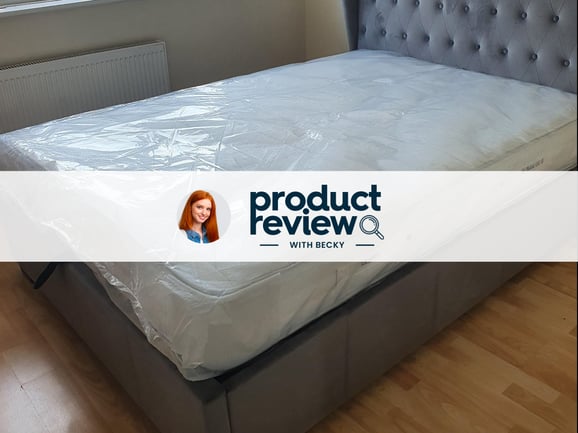
Why our sleep experts loved it
The Ultra 300 Mattress came across in the showroom as a familiar Mlily rolled-foam design with a cooler, glossier top treatment. It felt very close to the Ultra 250, with the added gel layer doing most of the work in making it seem a step up. I can see the appeal at first touch. I still do not think the price I saw sits comfortably with the construction.
This is a 30 cm deep mattress, so it looks substantial on a bed frame. It also creates a few day-to-day irritations. Standard fitted sheets may pull tight at the corners, and rotation will not be much fun once you move beyond a double. The double weighs 30 kg, the king 35 kg and the super king 42 kg. Manageable with two people. A nuisance on your own.
How the build came across in store
The spec is all foam: memory foam with cooling gel at the top, then soft comfort foam, responsive transition foam, zoned support foam and a high-density support base. No springs. No pillow top. No natural filling layer. For a rolled foam mattress, that is a straightforward recipe, and the in-store feel matched that description fairly closely.
The cover is 60% polyester and 40% ice yarn. It felt cool under my hand for the first contact, although showroom air conditioning can flatter this sort of fabric. Overnight heat is the unanswered part here. A brief lie-down cannot show how the gel and cover behave after several hours under a duvet, and foam mattresses often lose that initial cool touch once body heat builds.
The cover can be removed, yet it is dry clean only. That is a poor compromise for a mattress sold with a practical, modern feel. A protector is strongly advised in the care notes, and I would treat that as essential rather than optional. The hypoallergenic claim is believable enough, since the fill is foam and gel without wool or feather content, so there is little here to upset most allergy sufferers.
Feel, pressure relief and movement
In store, I would call it a medium tension. The published firmness also gives it as medium, and that fits my testing. There is a softening at the surface before the support layer firms things up, so the shoulder gets some room when side lying. It did not have the dense, slow-melting feel I associate with Tempur; it is lighter and a bit easier to move on.
The zoned support layer is meant to help the shoulders, hips and lower back. I could feel general contouring, though I would be careful about reading too much into the zoning from a showroom test. Five minutes on a display bed tells you shape and initial comfort. It does not tell you whether the hip area stays level after three months of nightly use.
Partner disturbance should be fairly well controlled because there is no spring unit pushing movement across the bed. I did not get a proper two-person night test, so I would not oversell that point. The surface absorbed movement well enough during handling and lying down. Quiet, composed, unshowy.
Who I think it suits
Side sleepers are the clearest audience. Average-weight people should get the easiest comfort here, since the medium feel gives enough cushioning without turning sloppy straight away. Back sleepers can use it too, provided they like a little contour around the pelvis.
People who sleep on their front should be more cautious. A medium all-foam mattress at this depth may allow the hips to settle too far, and that can pull the lower back into an uncomfortable angle. Heavier back sleepers may also want a firmer product for a steadier platform.
Best match: average-weight side sleepers.
Also workable: many back sleepers who prefer a cushioned medium feel.
Care point: it does not need turning, although regular rotation is still required.
Base warning: slat gaps must be 7.5 cm or narrower, or dipping may invalidate the guarantee.
Value and my buying advice
The care notes say to let it recover fully after unrolling and air it for 4 hours before use. Indentations caused by settlement or body weight are classed as normal. That wording matters with foam, because early showroom comfort can feel persuasive while long-term body impressions are the real test.
My issue is value. Mlily makes good mattresses, and this one did not feel cheap in the shop, yet the specification reads like a competent rolled foam model with a cooling upgrade. At close to Tempur pricing, I would be trying the Tempur One before committing, because its foam feel has a clearer identity. Around £550, perhaps £600 at a push, the Ultra 300 makes far better sense. Above that, the thick profile and cool-touch cover are doing too much of the selling.
Why you can trust WantMattress
We spend hours testing (and/or researching) every product or service we review, so you can be sure you’re buying the best. Find out more about
how we test .
Published: 7 June 2026
Peer reviewed by
Ron Burns , Staff Writer and Editor